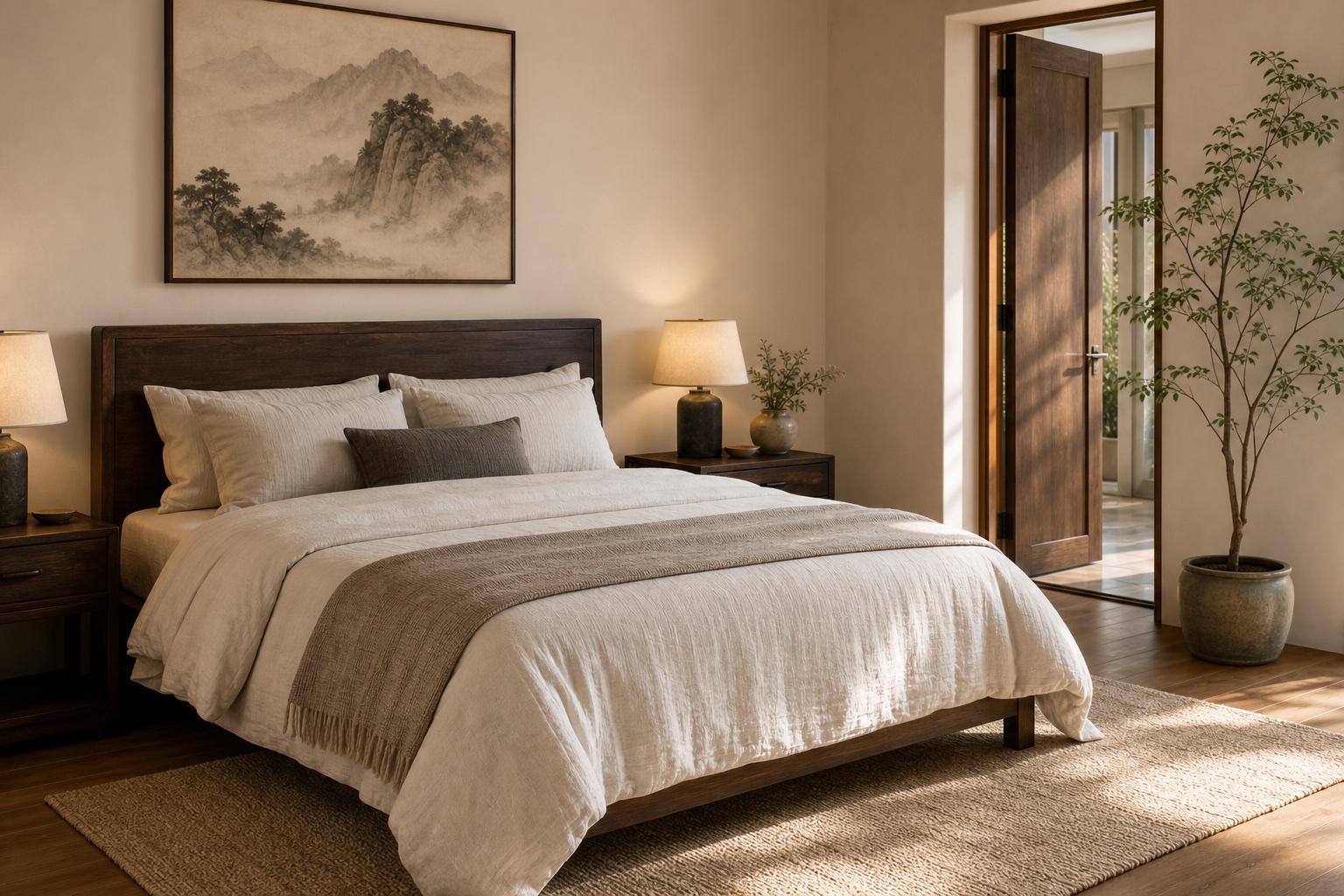
Bedroom Feng Shui is often presented as a list of frightening taboos. A more useful approach is to ask a simple question: does the room feel protected, quiet, and easy to rest in?
Traditional Feng Shui describes this quality through the movement of qi. Modern readers can also understand it through practical design: a stable headboard, a clear path to the door, gentle lighting, and fewer visual distractions. The ideas below are cultural guidelines rather than medical advice or guarantees about sleep.
The best Feng Shui bed placement
The classic starting point is the command position. Place the bed where you can see the bedroom door without lying directly in line with it. Ideally, the headboard rests against a solid wall and there is room to approach both sides.
This arrangement creates a sense of oversight without putting the bed in the busiest path through the room. If your layout allows it:
- keep the headboard on a solid, uninterrupted wall;
- avoid placing the bed directly beneath a window;
- leave a comfortable walkway around the bed;
- use two bedside surfaces when designing a shared bedroom;
- keep heavy shelves and large hanging objects away from the head of the bed.
There is no single compass direction that works for every home. Room shape, doors, windows, noise, temperature, and the people using the space matter more than forcing an impractical direction.
Should the bed face the door?
In traditional Feng Shui, a bed directly aligned with the door is sometimes called the “coffin position.” The dramatic name refers to the way the feet point straight toward the doorway.
If possible, shift the bed so it sits diagonally from the door. When that is not realistic, create a gentler visual boundary with a bench at the foot of the bed, a low screen, or a rug that defines the sleeping area. Do not add a tall cabinet that narrows an emergency exit or makes a small room harder to move through.
Mirrors facing the bed
Many Feng Shui schools discourage a mirror that reflects the bed. The traditional explanation is that mirrors keep energy active in a room intended for rest. There is also a straightforward design reason: reflections, streetlight, and sudden movement can be visually distracting at night.
Try moving the mirror to the inside of a wardrobe door, angling it away from the mattress, or using a curtain if the mirror is fixed. A mirror does not need to be removed simply because it is in the bedroom; the important question is whether it creates glare or makes you uncomfortable.
Bedroom doors, bathroom doors, and clear paths
Keep the route from the bed to the bedroom door open and easy to use. In Feng Shui language, this gives qi space to circulate. In everyday terms, it reduces clutter and makes the room feel calmer.
For an en-suite bathroom:
- repair leaks and manage humidity;
- use effective ventilation;
- keep toiletries organized;
- close the door when privacy or light is an issue;
- place the bed so the bathroom is not the first view on waking, when possible.
You do not need crystals or a complicated cure. Good maintenance and a clear visual transition usually do more for the room.
Bedroom Feng Shui for a small room
Small bedrooms rarely allow a textbook layout. Choose the most workable compromise:
- Prioritize a solid headboard and a safe path to the door.
- If the bed must sit below a window, use a secure headboard and curtains that control light without blocking ventilation.
- If only one side of the bed is accessible, keep that route clear.
- Use closed storage to reduce visual noise, but avoid packing the room with oversized furniture.
- Build a layered lighting plan: ambient light, a reading light, and low light for evening.
Colors and materials for a calmer bedroom
Feng Shui color advice is symbolic, not universal. Muted earth tones can feel grounding; soft greens can suggest the Wood phase and renewal; warm whites create breathing room. Choose a limited palette that suits the actual light in your space.
Natural textures—linen, wood, paper, wool, or woven fibers—can add warmth without making the bedroom ornate. Keep strong red, glossy black, and highly reflective finishes as accents if they feel too stimulating in large areas.
Bedroom Feng Shui checklist
- Can you see the door from the bed without lying directly in its path?
- Does the headboard feel stable?
- Are mirrors and screens free from distracting reflections?
- Is there a clear walkway?
- Are leaks, humidity, noise, and harsh light addressed?
- Does the room feel restful to the people who actually sleep there?
Start with function, then add symbolism. A thoughtful bedroom Feng Shui layout should make daily life easier—not make you anxious about rules.