Name the context
Separate documented history, living custom, modern interpretation, and our own reflective exercises.
Deities, Customs & Prosperity Symbols
Explore Caishen, New Year customs, Feng Shui wealth-area methods, coins, Jin Chan, Pixiu, and prosperity symbols without financial promises.
Explore by topic
A grounded approach
Separate documented history, living custom, modern interpretation, and our own reflective exercises.
Use natural English while keeping Chinese terms and their cultural setting visible.
Present symbolic or traditional frameworks as such, and describe measurable conditions separately.
Selected reading
Guide 01
Meet Caishen, the Chinese God of Wealth, through names, historical images, different identities, Lunar New Year traditions, and careful modern interpretation.
Read the guideGuide 02
Find a Feng Shui wealth corner without pretending there is one universal answer: compare common maps, name the method, and improve the real space first.
Read the guideGuide 03
Learn what the three-legged Money Frog or Jin Chan represents, how it relates to Liu Hai, how to identify one, and how placement customs differ.
Read the guideGuide 04
Understand Feng Shui coins as historical coin forms and modern symbolic replicas, with guidance on inscriptions, groupings, display traditions, and material care.
Read the guideGuide 05
Identify Chinese wealth symbols by category—from Caishen and ingots to fish, Jin Chan, Pixiu, coins, peonies, and wordplay—without treating them as interchangeable.
Read the guideGuide 06
Explore how Caishen appears in Lunar New Year prints, household customs, greetings, and modern celebrations—while respecting regional and religious differences.
Read the guideGuide 07
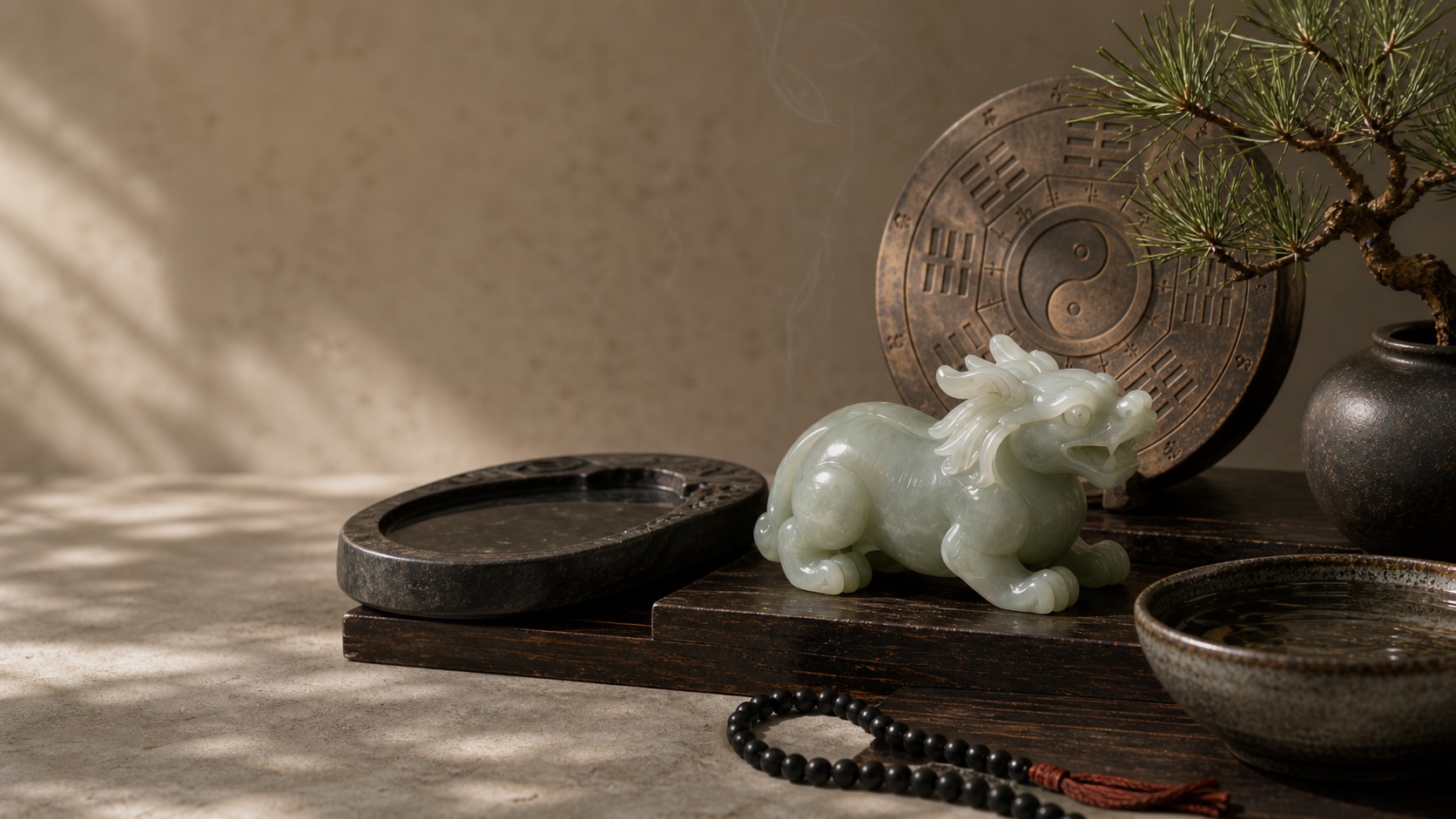
Explore Pixiu as a Chinese mythical creature, its connection to Bixie and Tianlu, and how the motif appears in modern Feng Shui and jewelry.
Read the guideGuide 08
Learn how Pixiu bracelets are traditionally worn, which hand people choose, how the charm faces, and how to care for the materials.
Read the guide