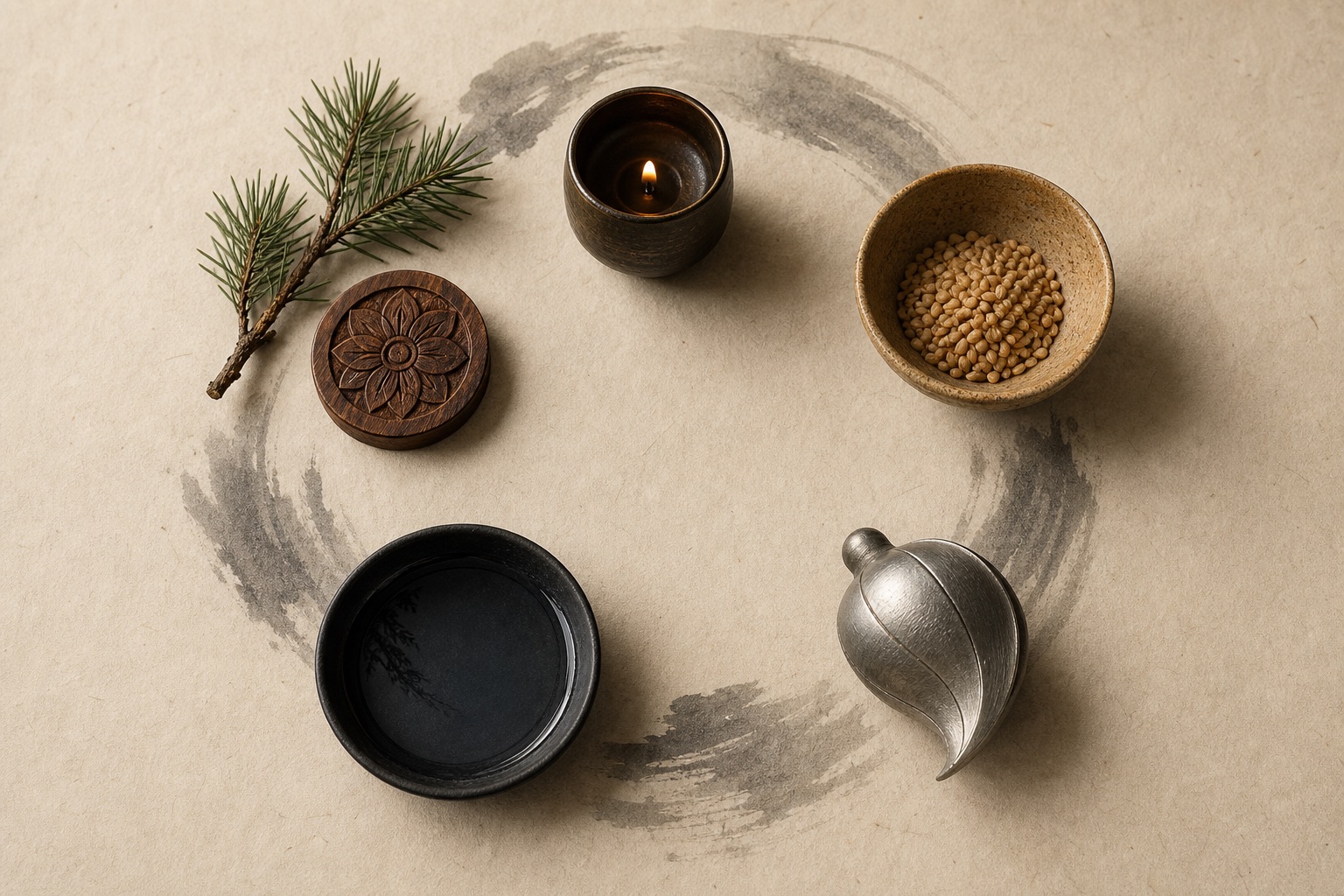
The Five Elements of Feng Shui are Wood, Fire, Earth, Metal, and Water. The Chinese term is wuxing (五行), and “Five Phases” is often a better translation than “Five Elements.” These are not fixed substances in the Western classical sense. They describe patterns of change and relationships.
That distinction matters. A room is not harmonious because it contains five decorative objects in five colors. The framework is about how qualities support, moderate, or transform one another.
The five phases at a glance
| Phase | Chinese | Traditional season | Direction | Common colors | Design qualities |
|---|---|---|---|---|---|
| Wood | 木, mù | Spring | East | green, teal, natural wood | growth, flexibility, upward movement |
| Fire | 火, huǒ | Summer | South | red, coral, warm orange | warmth, visibility, expression |
| Earth | 土, tǔ | seasonal transitions / center | Center | ochre, clay, sand | stability, connection, support |
| Metal | 金, jīn | Autumn | West | white, gray, metallic tones | structure, refinement, precision |
| Water | 水, shuǐ | Winter | North | black, ink blue | depth, reflection, movement |
Associations vary by school and period. Treat the table as a map of relationships, not a list of universal prescriptions.
Wood: growth and direction
Wood is associated with spring, plants, expansion, and forms that rise. In an interior, it can appear as timber, living plants, botanical patterns, or vertical lines.
Too little Wood may make a room feel static. Too much can feel crowded or visually restless. A single healthy plant or a well-proportioned wood table is often more effective than filling every corner with greenery.
Fire: warmth and visibility
Fire relates to summer, light, warmth, and expression. Lighting is the most literal way to introduce this quality. Red and warm colors can also act as Fire accents.
Because Fire is visually dominant, small amounts can change a room quickly. A warm lamp, a cinnabar-colored textile, or an artwork with active movement may be enough.
Earth: stability and connection
Earth provides visual weight. Clay, stone, ceramics, low horizontal forms, and warm mineral colors can make a space feel grounded.
Earth does not have to mean beige. Terracotta, muted yellow, earthen green, and natural stone all belong to a broader material language of support and tactility.
Metal: clarity and structure
Metal is associated with autumn, definition, and refinement. In a room, it may appear as hardware, metalwork, circular forms, white space, or a precise organizational system.
Metal can bring order to a busy space. If overused, highly polished surfaces and cool grays may feel severe; soften them with textile, wood, or warm light.
Water: depth and movement
Water is linked with winter, reflection, and flow. Dark blue, black, glass, asymmetrical shapes, and images of rivers or mist can express Water without installing a fountain.
Actual water features require maintenance. A neglected fountain is less harmonious than a clean, well-composed artwork.
The generating cycle
The generating cycle describes how one phase supports the next:
Wood → Fire → Earth → Metal → Water → Wood
- Wood feeds Fire.
- Fire produces ash, associated with Earth.
- Earth bears minerals and Metal.
- Metal is traditionally associated with collecting or generating Water.
- Water nourishes Wood.
In design, use this as a way to build transitions. A wood table with warm lighting and a ceramic vessel moves through Wood, Fire, and Earth without turning the room into a diagram.
The controlling cycle
The controlling cycle explains moderation:
Wood → Earth → Water → Fire → Metal → Wood
Wood parts Earth, Earth contains Water, Water moderates Fire, Fire melts Metal, and Metal cuts Wood. “Control” does not automatically mean conflict. It can describe the restraint that keeps one quality from dominating.
How to use the Five Elements at home
- Describe the room as it is: bright or dim, hard or soft, busy or sparse.
- Identify the quality that is excessive or missing.
- Add the smallest useful adjustment—a material, light source, shape, or color.
- Live with it before adding more.
- Judge the result by comfort and function, not by whether every phase is visibly represented.
The Five Phases are a cultural model of dynamic balance. They can enrich a modern home when used thoughtfully, without turning symbolic associations into rigid rules.
To use the framework as a reflective sequence rather than a room-design formula, try our Five Elements meditation. The article labels its guided practice as a modern adaptation rather than an ancient standardized method.
Further reading
- Chinese Philosophy and Chinese Medicine, Stanford Encyclopedia of Philosophy
- Divinities of the Planets and Constellations, The Metropolitan Museum of Art