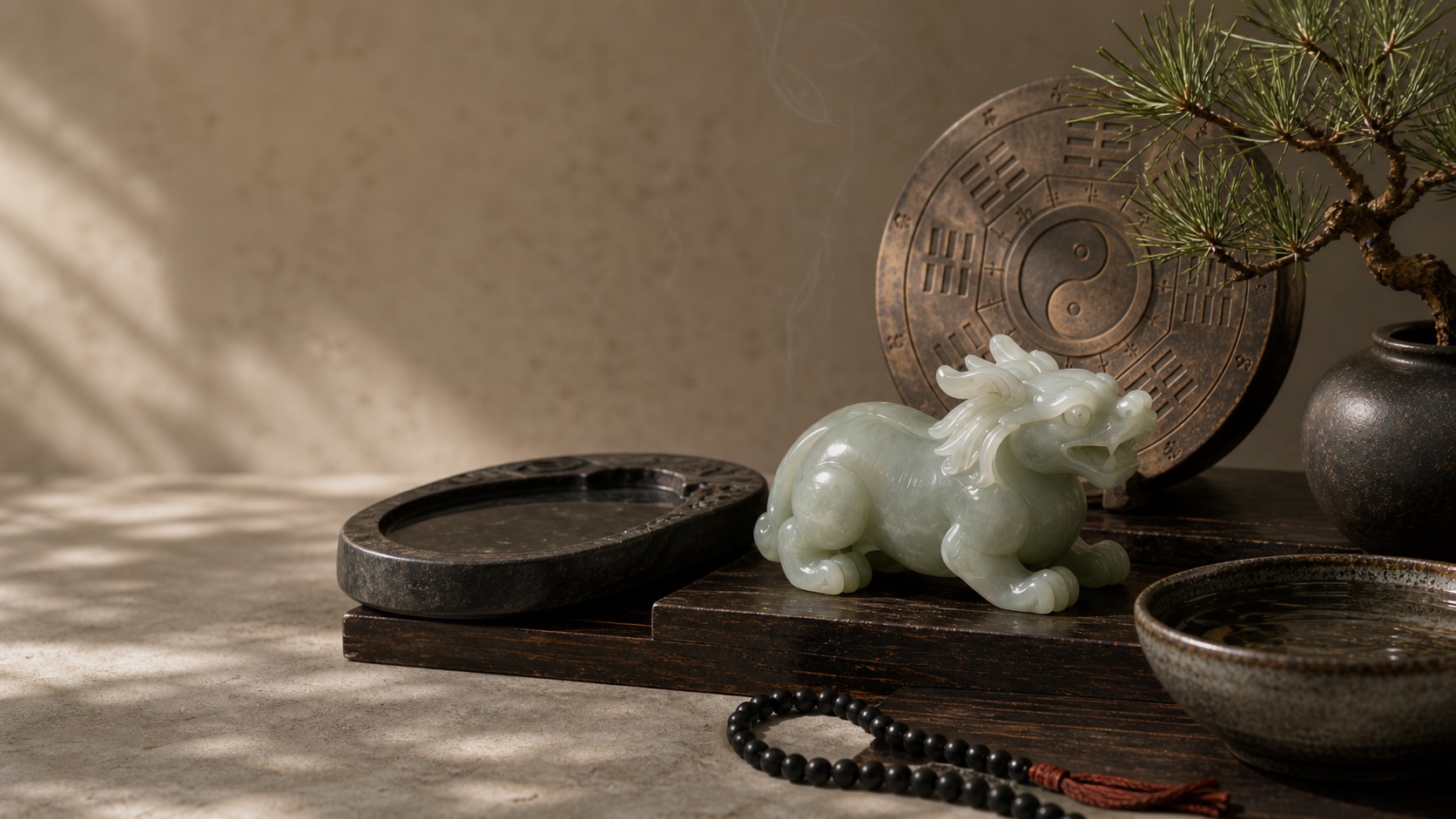
Pixiu (貔貅, often written Pi Xiu) is the modern name widely used for an auspicious Chinese mythical beast. It is commonly represented with a powerful feline body, a horned or dragon-like head, and sometimes wings. In contemporary Feng Shui and jewelry, Pixiu is especially associated with prosperity and protection.
The familiar story that Pixiu consumes treasure but cannot expel it is popular in modern practice. It helps explain why the creature appears on bracelets, pendants, desk ornaments, and business displays. That story should be understood as symbolic folklore, not a promise that an object changes a person’s finances.
Pixiu, Bixie, and Tianlu
The terminology is more complicated than many retail guides suggest. Ancient and later Chinese art includes families of winged, horned, feline-like creatures described by names such as bixie (辟邪), tianlu (天禄), and qilin (麒麟). Modern sources sometimes combine these traditions under “Pixiu.”
- Bixie can be translated as “warding off evil” and is often associated with protective creatures.
- Tianlu carries an association with heavenly emolument or prosperity.
- Pixiu has become the most familiar commercial and Feng Shui label for the wealth-associated beast.
Claims that one-antlered and two-antlered forms are always male and female are common online, but the identification of historical objects is not that tidy. Museum catalogues often use broader terms such as chimera or mythical beast.
A history visible in Chinese art
Mythical feline creatures appear in Chinese art from at least the Han period onward. A second-century BCE gilt bronze weight in The Metropolitan Museum of Art, for example, takes the form of a winged and horned chimera. Another gilt bronze Bixie in the museum dates to the Six Dynasties period.
These objects are valuable evidence that protective hybrid beasts have a long visual history. They do not prove every modern bracelet rule or wealth ritual. The modern Pixiu tradition brings older imagery together with later folklore, Feng Shui practice, and contemporary design.
What does Pixiu symbolize today?
Pixiu is commonly used to express:
- the wish to gather and preserve resources;
- vigilance and protection;
- courage and authority;
- auspicious business or career intentions;
- respect for Chinese symbolic culture.
For some people the object is devotional or spiritually meaningful. For others it is art, jewelry, or a reminder to manage money carefully. These uses can coexist.
How Pixiu is used in Feng Shui
Modern Feng Shui advice often places a Pixiu figure in an office, living room, or entry area with the head facing outward. The gesture symbolizes looking for opportunity beyond the home.
If you display one:
- Choose a clean, stable surface.
- Do not block a walkway or create visual clutter.
- Let the figure face into the room or toward an open area according to the meaning you prefer.
- Keep it out of damp places where the material may deteriorate.
- Treat inherited, antique, or religious objects according to their actual provenance rather than generic internet rules.
There is no need to place the object in a mathematically fixed “wealth corner” if that location is impractical. Thoughtful placement and care are more respectful than anxiety about a taboo.
If a Pixiu enters a meditation space, let it remain a meaningful cultural object rather than an “energy tool.” Our guide to qi in Feng Shui explains why symbolic qi should not be marketed as a measurable force or guaranteed outcome.
Pixiu in bracelets and jewelry
Bracelets often pair a Pixiu bead with obsidian, jade, quartz, or metal. Before buying, look beyond the symbolism:
- Is the material accurately described?
- Are treatments or plating disclosed?
- Is the carving crisp and securely drilled?
- Is the cord durable and replaceable?
- Does the seller avoid guaranteed wealth claims?
Transparent craftsmanship and cultural explanation are signs of a stronger product.
Is Pixiu the same as a dragon?
No. A modern Pixiu may borrow dragon-like features, but it belongs to a broader family of hybrid auspicious beasts. It is also distinct from the qilin, although historical labels and visual traits sometimes overlap.
A culturally grounded interpretation
Pixiu is most interesting when it is not reduced to a “money magnet.” It connects ancient Chinese art, protective imagery, later folklore, and the modern desire to give material objects personal meaning.
Compare it with Caishen, Jin Chan, coins, and other Chinese wealth symbols, or follow the complete Wealth & Prosperity reading path. These forms can share an auspicious setting without having the same identity or history.
If you wear the motif, treat it as culture and craft first. For practical guidance, continue with How to Wear a Pixiu Bracelet.
Further reading
- Chimera (Bixie), 3rd–6th century, The Metropolitan Museum of Art
- Recent Acquisitions: Weight in the Shape of a Chimera (Bixie), The Metropolitan Museum of Art