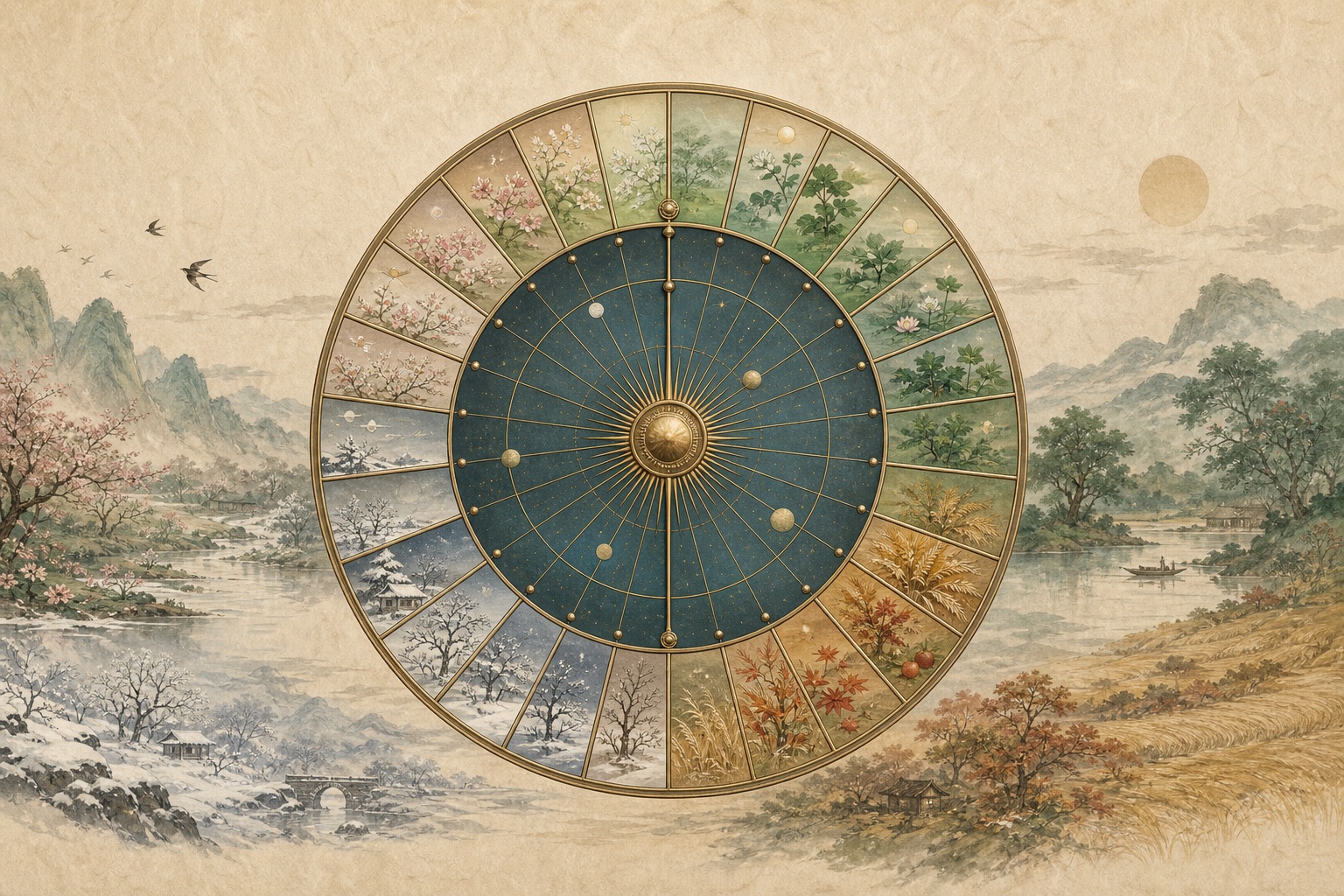
The 24 solar terms divide the Sun’s apparent annual path into 24 equal sections of 15 degrees. Each term marks an astronomical point and carries a seasonal name such as Beginning of Spring, Grain Rain, Major Heat, or White Dew. Developed in China as a framework for agriculture and daily life, the system remains a cultural calendar—not a guaranteed weather forecast for every place on Earth.
In brief: A new solar term begins roughly every 15 days. The dates stay near the same Gregorian dates each year, but the exact time changes. Use the terms to observe seasonal change, while adapting their imagery to your local climate and hemisphere.
Contents
- What are the 24 solar terms?
- All 24 solar terms in order
- How the solar terms are calculated
- History, agriculture, and living tradition
- How to use the terms outside China
- Solar terms and the Five Elements
- Frequently asked questions
What are the 24 solar terms?
The 24 solar terms—ershisi jieqi (二十四节气)—are markers in the traditional Chinese lunisolar calendar. Unlike lunar months, the terms follow the Sun. They help keep seasonal reckoning aligned with the solar year and historically guided decisions about sowing, harvest, water, frost, and rural work.
UNESCO describes the system as knowledge developed through observation of the Sun’s annual motion, originating in the Yellow River region and progressively applied across China. It was inscribed on the Representative List of the Intangible Cultural Heritage of Humanity in 2016 (UNESCO).
The names combine different kinds of information:
- Seasonal thresholds: Beginning of Spring, Summer, Autumn, and Winter.
- Astronomical events: Spring Equinox, Summer Solstice, Autumn Equinox, Winter Solstice.
- Temperature patterns: Minor Heat, Major Heat, Minor Cold, Major Cold.
- Moisture and precipitation: Rain Water, White Dew, Cold Dew, Minor Snow, Major Snow.
- Agricultural observation: Grain Rain, Grain Buds, Grain in Ear.
- Phenological imagery: Awakening of Insects and Clear and Bright.
These names reflect long observation in historical Chinese environments. “Minor Snow” does not promise snow in Los Angeles, Cape Town, or Singapore on that date.
All 24 solar terms in order
Approximate Gregorian dates below may shift by a day depending on the year and time zone. Solar longitude is the Sun’s apparent position along the ecliptic in the standard modern calculation.
| Season group | Pinyin | Common English name | Approximate date | Solar longitude |
|---|---|---|---|---|
| Spring | Lichun | Beginning of Spring | February 4 | 315° |
| Spring | Yushui | Rain Water | February 19 | 330° |
| Spring | Jingzhe | Awakening of Insects | March 5 | 345° |
| Spring | Chunfen | Spring Equinox | March 20 | 0° |
| Spring | Qingming | Clear and Bright | April 4 | 15° |
| Spring | Guyu | Grain Rain | April 20 | 30° |
| Summer | Lixia | Beginning of Summer | May 5 | 45° |
| Summer | Xiaoman | Grain Buds / Lesser Fullness | May 21 | 60° |
| Summer | Mangzhong | Grain in Ear | June 5 | 75° |
| Summer | Xiazhi | Summer Solstice | June 21 | 90° |
| Summer | Xiaoshu | Minor Heat | July 7 | 105° |
| Summer | Dashu | Major Heat | July 23 | 120° |
| Autumn | Liqiu | Beginning of Autumn | August 7 | 135° |
| Autumn | Chushu | End of Heat | August 23 | 150° |
| Autumn | Bailu | White Dew | September 7 | 165° |
| Autumn | Qiufen | Autumn Equinox | September 23 | 180° |
| Autumn | Hanlu | Cold Dew | October 8 | 195° |
| Autumn | Shuangjiang | Frost’s Descent | October 23 | 210° |
| Winter | Lidong | Beginning of Winter | November 7 | 225° |
| Winter | Xiaoxue | Minor Snow | November 22 | 240° |
| Winter | Daxue | Major Snow | December 7 | 255° |
| Winter | Dongzhi | Winter Solstice | December 21 | 270° |
| Winter | Xiaohan | Minor Cold | January 5 | 285° |
| Winter | Dahan | Major Cold | January 20 | 300° |
The sequence traditionally begins with Lichun, even though January’s Minor Cold and Major Cold appear earlier in a Gregorian calendar year. That difference is another reason not to assume January 1 is the starting point for every Chinese calendrical cycle.
How the solar terms are calculated
Imagine the Sun’s apparent path around the celestial sphere as a 360-degree circle. Divide it into 24 equal arcs and each arc spans 15 degrees. The Hong Kong Observatory explains the solar terms through these equal divisions of the ecliptic (24 Solar Terms).
Four positions will already be familiar:
- Spring Equinox: 0°
- Summer Solstice: 90°
- Autumn Equinox: 180°
- Winter Solstice: 270°
The four “Beginnings” fall halfway between the solstices and equinoxes in this astronomical framework. Lichun at 315° comes before the March equinox; Liqiu at 135° comes before the September equinox.
Because Earth’s orbit and civil timekeeping do not divide into neat whole days, an exact term can begin at a different hour each year. Time zone also changes the displayed local date. For a dated article or event, use an astronomical calendar for the year and location instead of repeating a permanent date from memory.
History, agriculture, and living tradition
The 24 solar terms are sometimes presented as a mystical forecast, but their historical importance is practical. A lunisolar calendar needs solar anchors, and farming communities need a shared language for recurring work and environmental change.
Over time, terms accumulated regional foods, festivals, proverbs, crafts, games, and ceremonies. Qingming, for example, is both a solar term and the setting for a major remembrance festival. Dongzhi supports different family food traditions across regions. The meaning of a term therefore includes astronomy, work, memory, and local practice.
Traditional almanacs also divide each term into three roughly five-day observations, often called pentads or hou. These describe signs such as plants, winds, insects, birds, frost, or water. They are valuable historical environmental poetry. They should not be treated as universal biological events occurring simultaneously across every latitude.
UNESCO emphasizes that the system continues through formal and informal transmission, including rituals, sayings, songs, crafts, and family knowledge. This living dimension matters: intangible heritage is not preserved by freezing one “official” lifestyle for all readers.
How to use the terms outside China
For a worldwide audience, the most respectful approach is observe first, adapt second.
Keep the astronomical marker
The solar longitude is global. An equinox or a 15-degree division does not disappear when you leave China. Use the exact term as a moment to pause and notice the year moving.
Translate climate imagery carefully
The seasonal names arose from conditions in and around historical northern-central China, then acquired varied meanings across a large country. Compare the name with your own weather rather than declaring that autumn “has arrived” everywhere on Liqiu.
Reverse the practical season in the Southern Hemisphere
In Sydney or Cape Town, August belongs to late winter rather than the beginning of autumn. You can still study Liqiu as Chinese cultural heritage, but an autumn home-maintenance or food routine may fit your local February better. Separate the traditional calendar date from your ecological season.
Use local, seasonal materials
You do not need imported ingredients to perform authenticity. Visit a local market, notice what is ripening, document the light, and choose foods appropriate to your climate and health needs. If you prepare a documented regional Chinese custom, name its origin instead of presenting it as something all Chinese people do.
Build a small observation ritual
At each term, record sunrise and sunset, temperature, rainfall, one plant, one animal behavior, and one household task. After a year, you will have a local seasonal calendar in conversation with the traditional one.
A tea meditation can become another seasonal observation: compare water temperature, aroma, taste, local light, and the social setting without declaring one tea mandatory for every climate.
Solar terms and the Five Elements
Traditional correspondences often connect spring with Wood, summer with Fire, autumn with Metal, winter with Water, and seasonal transitions or the center with Earth. This is a symbolic map of change, not a meteorological formula.
The useful design question is not “Which colored object must I buy?” It is “What quality is the season asking me to notice?” Spring may suggest growth and editing space for new activity. Autumn may suggest refinement and letting go. Winter may invite storage, repair, and quieter light.
Read our Five Elements guide for the generating and controlling cycles. The Five Elements meditation turns the phases into a modern reflective practice while keeping local seasons and cultural sources distinct. For a worked seasonal example, continue with Beginning of Autumn (Liqiu).
Frequently asked questions
Are the 24 solar terms based on the Moon?
No. They are based on the Sun’s apparent annual path. They help a lunisolar calendar remain connected to the solar year.
Do the 24 solar terms fall on the same dates every year?
They stay near the same Gregorian dates but can shift by a day, and the exact local time changes. Check the year and time zone when precision matters.
Are the solar terms seasons?
They divide the year into 24 markers, with six terms grouped under each traditional season. They are not identical to four meteorological seasons used by modern weather agencies.
Why are there two English names for some terms?
Chinese terms carry agricultural and poetic meanings that do not always map cleanly to one English phrase. Xiaoman, for example, appears as Grain Buds, Lesser Fullness, or Grain Full depending on the translator. Including pinyin preserves a stable reference.
Can I follow the solar terms in the Southern Hemisphere?
Yes, as a cultural and astronomical study. Keep the Chinese calendar date visible, but adapt seasonal food, clothing, home care, and outdoor activity to your actual local season.
Are solar-term wellness practices medical treatments?
No. Seasonal routines can support reflection and ordinary self-care, but the term itself does not diagnose a condition. Food, herbs, exercise, or breath practices should not replace qualified medical advice.
Let the calendar sharpen observation
The 24 solar terms combine astronomy with generations of environmental and cultural attention. Their value for a global reader is not pretending that one regional weather pattern covers the planet. It is learning the exact annual structure, understanding where the names came from, and using each marker to look more closely at the season you actually inhabit.