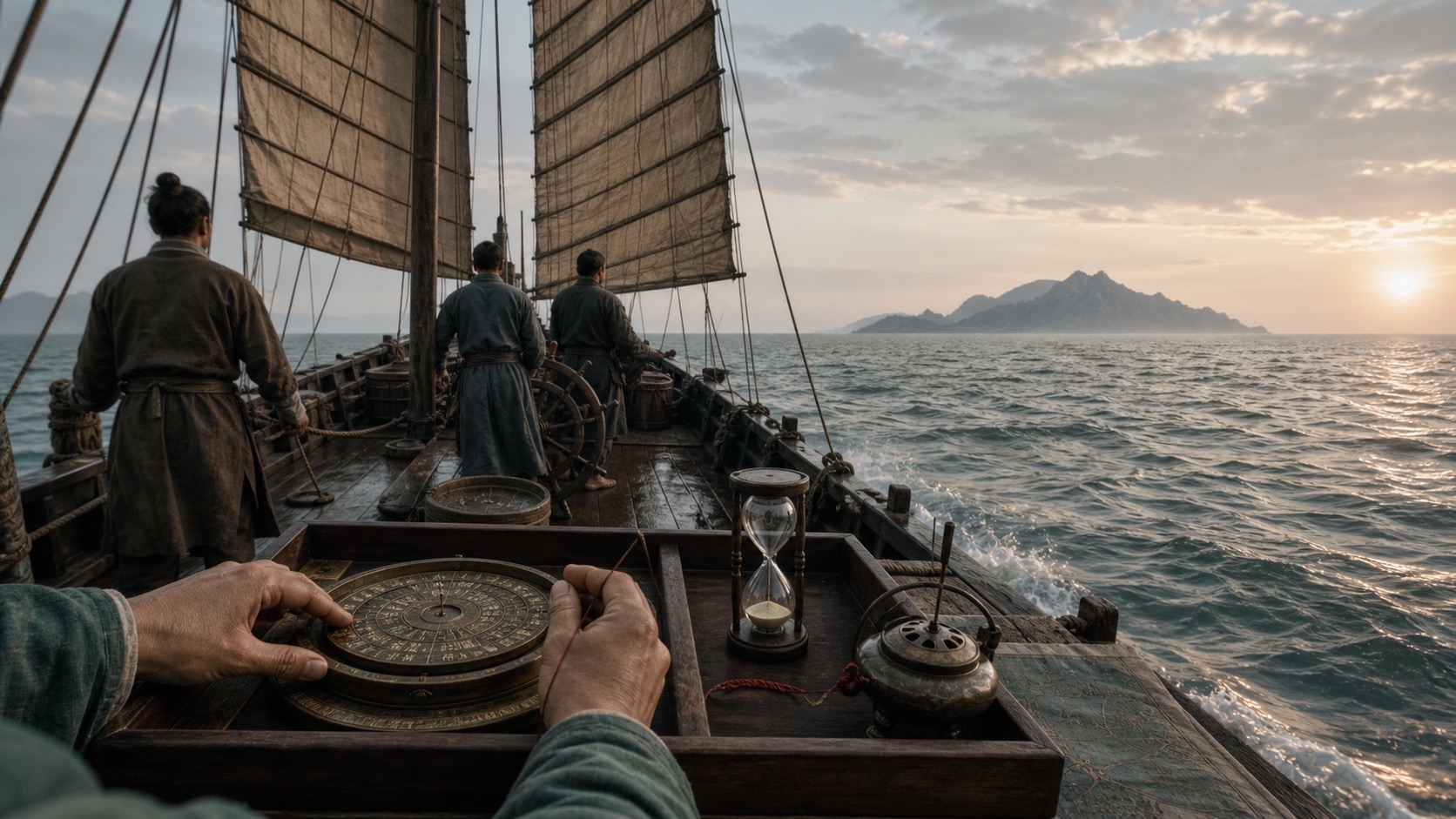
In late-imperial Chinese navigation, geng (更) could measure a leg of a voyage. Sailing manuals recorded routes in a practical form: steer in a named compass direction for a stated number of geng to reach the next landmark or destination. In a documented navigational convention, ten geng equaled one full 24-hour day, making one geng 2.4 modern hours for that calculation.
In brief: Geng did not have only one use. On land it commonly names a night watch; at sea it could become a voyage-duration unit that helped estimate progress along a compass course. Convert it only after identifying the manual’s convention, because the maritime ten-geng day is not automatically the same as five seasonal night watches.
Contents
- A route written as direction plus time
- The ten-geng navigational day
- How sailors measured a geng
- From duration to estimated distance
- Why sea geng and night geng differ
- How to read a sailing instruction
- Frequently asked questions
A route written as direction plus time
Chinese sailing manuals described navigational knowledge as sequences of actions. A simplified instruction might read:
from A, follow direction x for y geng, then reach BThe actual sources use compass-bearing terminology, landmarks, depths, hazards, currents, stars, and other practical information. The direction-and-geng structure is important because it joins two things a navigator can act on: where to point the vessel and how long to maintain the course.
This is not a modern coordinate. Wind, current, sea state, vessel, loading, and steering all affect the track. Yet an experienced maritime community could make the formula useful by combining written instruction with practiced judgment.
The ten-geng navigational day
Research in the Journal of Chinese History describes Chinese navigation manuals in which 10 geng equal 24 hours. Under that explicit rule:
| Geng | Modern duration |
|---|---|
| 1 geng | 2 hours 24 minutes |
| 2 geng | 4 hours 48 minutes |
| 5 geng | 12 hours |
| 10 geng | 24 hours |
The arithmetic is straightforward:
24 hours ÷ 10 geng = 2.4 hours per gengThis conversion belongs to that navigation system. It should not be used to “correct” every appearance of geng in a poem, city watch call, court schedule, or mechanical watch clock.
The broader lesson is the same as in Ancient Chinese Time Conversion: identify the system before converting the number.
How sailors measured a geng
A vessel needs a repeatable way to judge elapsed time when the coast, Sun, and stars are not sufficient. Scholarship on East and Southeast Asian Chinese navigation notes the use of timekeeping aids such as incense and hourglasses in the navigational environment.
Neither device makes a voyage mechanically exact. Incense burn changes with material and conditions; an hourglass must be turned and observed; crews need consistent practice; and storms can disrupt every routine. The devices support an embodied process rather than replacing judgment.
The watch also organizes labor. A long passage needs changing crews, repeated observations, and memory of the last course. Timekeeping helps turn continuous sailing into accountable segments.
For the object history of burning-time devices, read How an Incense Clock Works.
From duration to estimated distance
Time can stand in for distance only through speed. If navigators expect a typical vessel to cover a typical amount of water in one geng, a route manual can use geng as a practical distance estimate.
But speed over water and progress over the ground are not identical. A current may help or resist the vessel; a crosswind may force a different heading; bad visibility can change decisions. This is why “two geng” should be understood as operational knowledge, not a universal number of kilometers.
The instruction is best read as: maintain this course for the amount of voyage time that experienced navigators call two geng, while checking the surrounding evidence.
Why sea geng and night geng differ
The familiar five night watches divide the darkness from evening toward dawn. Their duration could change with seasonal night length. The navigational ten-geng day divides a full 24 hours for voyage calculation.
| Context | What geng organizes | Conversion warning |
|---|---|---|
| Urban or court night watch | The progress of nighttime | May vary seasonally |
| Literary night scene | Atmosphere or narrative period | Often approximate |
| Maritime manual | Course duration and voyage progress | Use the manual’s stated convention |
The same word can travel because both uses involve a watch or turn of time. Shared vocabulary does not require identical mathematics.
See Chinese Night Watches for the land-based five-watch system.
How to read a sailing instruction
Use this five-part method:
- Confirm the source is maritime. A compass course, island, depth, or route sequence is a strong clue.
- Find the geng rule. Use ten per day only when the manual or scholarship establishes it.
- Treat direction as historical compass language. Do not silently replace a named bearing with a modern decimal heading.
- Expect environmental correction. Wind, current, and observations modify the planned leg.
- Keep uncertainty in translation. “Sail for two watches (about 4.8 hours in this manual)” is transparent.
Frequently asked questions
How long was one geng at sea?
In the documented ten-geng-per-day convention, one geng equals 2.4 hours. Other sources must be checked rather than assumed.
Did sailors use clocks?
They used practical timekeeping methods, including incense and hourglasses in documented navigational settings, alongside celestial, compass, depth, coastal, and environmental knowledge.
Did one geng equal a fixed distance?
Not universally. It could support a conventional estimate of voyage progress, but actual distance depended on vessel speed, wind, current, and conditions.
Is maritime geng the same as third watch at night?
No. A maritime geng can belong to a full-day voyage calculation, while “third watch” belongs to a sequence organizing the night.
Why pair time with a compass direction?
Direction tells the crew where to steer; duration tells them how long to hold that leg before expecting the next waypoint or instruction.
At sea, time became a route
The maritime geng shows how adaptable traditional time vocabulary could be. A watch was not merely something announced after dark. In a sailing manual it became part of a route—direction plus duration, corrected by experience and the moving sea. Contrast that specialist unit with the land-based daily cycle in The 12 Shichen.