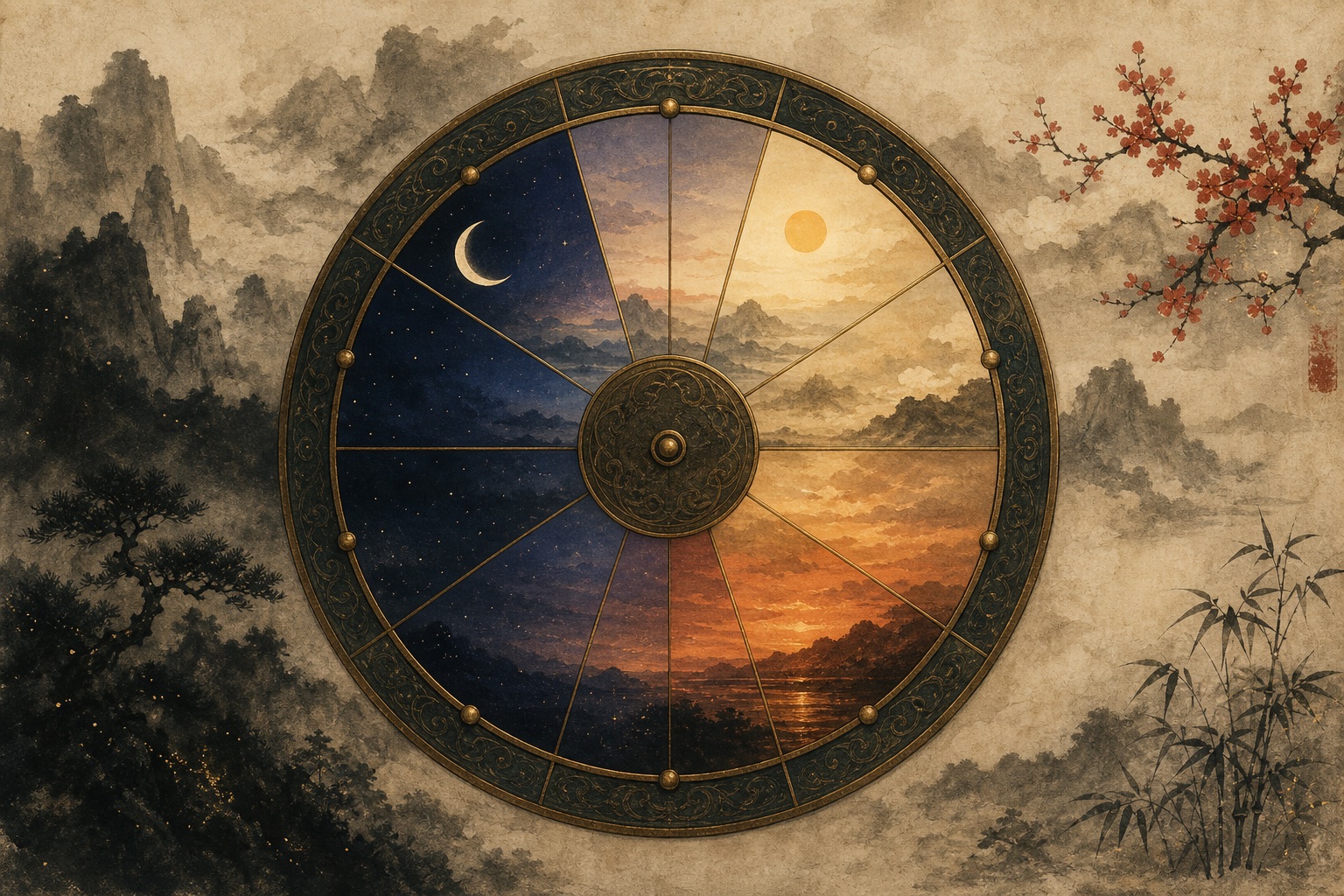
A shichen (时辰) is a traditional Chinese two-hour period. Twelve shichen make one full day: Zi begins at 11:00 p.m., Wu centers on noon, and Hai ends at 11:00 p.m. Each period corresponds to one of the 12 Earthly Branches and, by extension, one Chinese zodiac animal. This page is the main guide to FengShuiZen’s Chinese timekeeping collection.
In brief: A shichen is approximately two modern hours, not one. The 12-part system organized civil time, calendars, literature, ritual, astrology, and traditional medicine long before standardized time zones and digital clocks.
Contents
- The 12 shichen chart
- Explore Chinese timekeeping
- Why a shichen equals two modern hours
- How people kept time
- Earthly Branches, animals, and the calendar
- How shichen appear in culture
- Using shichen with modern birth times
- Frequently asked questions
The 12 shichen chart
| Shichen | Modern local time | Zodiac animal | Position in the day |
|---|---|---|---|
| Zi (子) | 11:00 p.m.–1:00 a.m. | Rat | midnight centered |
| Chou (丑) | 1:00–3:00 a.m. | Ox | deep night |
| Yin (寅) | 3:00–5:00 a.m. | Tiger | before dawn |
| Mao (卯) | 5:00–7:00 a.m. | Rabbit | dawn |
| Chen (辰) | 7:00–9:00 a.m. | Dragon | early morning |
| Si (巳) | 9:00–11:00 a.m. | Snake | late morning |
| Wu (午) | 11:00 a.m.–1:00 p.m. | Horse | noon centered |
| Wei (未) | 1:00–3:00 p.m. | Goat | early afternoon |
| Shen (申) | 3:00–5:00 p.m. | Monkey | late afternoon |
| You (酉) | 5:00–7:00 p.m. | Rooster | evening |
| Xu (戌) | 7:00–9:00 p.m. | Dog | early night |
| Hai (亥) | 9:00–11:00 p.m. | Pig | late night |
The Hong Kong Observatory publishes this conversion in its explanation of the stem-branch cycle (Heavenly Stems and Earthly Branches). English spellings can differ because pinyin without tone marks is only one romanization system.
Explore Chinese timekeeping
The shichen chart is the foundation, not the whole history. Follow the branch that matches your question:
System and conversion
- Why Zi Hour Starts at 11 PM explains the midnight-centered period and the modern date boundary.
- The 12 Earthly Branches connects hours with months, animals, directions, and the Four Pillars.
- Twelve Traditional Chinese Times of Day moves from yeban at midnight to rending at settled night.
- How to Convert Shi, Ke, Geng, and Dian helps readers translate historical units without false precision.
Instruments and public time
- How Ancient China Told Time compares sunlight, flowing water, burning incense, mechanisms, and public sound.
- Su Song’s Clock Tower explores one integrated Song-dynasty observatory and reporting machine.
- Chinese Water Clocks follows controlled flow from vessels to floats, scales, and trained readers.
- Incense Clocks uses surviving museum objects to explain a calibrated burning trail.
- When Chinese and European Clocks Met traces adaptation in the Ming-Qing court and regional workshops.
Night watches and public time
- Why the Five Night Watches Changed with the Seasons uses a Qing watch clock to correct the fixed two-hour shortcut.
- Night Watchmen in Ancient China treats gengfu as workers within public infrastructure.
- How Ancient Chinese Cities Announced the Time follows the chain from official reference to placards and sound.
Daily life, literature, and travel
- Was Wushi Sanke Really Execution Time? separates a famous literary deadline from universal legal history.
- Geng at Sea explains a watch as voyage time in Chinese sailing manuals.
- A Day in Ancient China Through the Twelve Shichen builds a source-bounded composite rather than one universal schedule.
- Shichen in Wuxia, Dramas, and Games provides a translation cheat sheet without false precision.
Birth hour and Four Pillars
- Chinese Zodiac Hours is the fast animal-by-time lookup.
- Birth-Hour Animal vs Year Animal distinguishes two positions in the branch cycle.
- The BaZi Hour Pillar explains why a complete pillar needs a stem as well as a branch.
- Early Zi and Late Zi Hour documents the 23:00 versus 00:00 day-boundary methods.
- How to Find Your Chinese Birth Hour starts from records, time zones, daylight saving, and boundary uncertainty.
Why a shichen equals two modern hours
The familiar modern day has 24 equal hours. The branch system divides that same day into 12 larger periods, so each corresponds to roughly two modern hours. Translating shi in shichen simply as “hour” can therefore cause confusion.
Zi straddles midnight from 11:00 p.m. to 1:00 a.m. Wu straddles noon from 11:00 a.m. to 1:00 p.m. This symmetry gives us the expression ziwu—midnight-noon—which appears in discussions of direction, time, calendars, and medicine.
The two-hour conversion is a modern standard reference. Historical time was experienced and measured through changing technologies, seasonal daylight, local observation, and administrative practice. Saying a text takes place “at Mao” communicates a period around dawn, not necessarily the precision of 5:37 a.m. on a standardized wristwatch.
How people kept time
Traditional Chinese timekeeping included several instruments and social signals. Sundials tracked the Sun when weather allowed. Water clocks measured controlled flow. Incense could mark duration in ritual or domestic settings. Drums, bells, watches, and night patrols announced periods to communities.
Shichen were also subdivided when greater precision was needed. The length and organization of smaller units changed across periods, so it is risky to convert every historical “mark” into one permanent number of modern minutes without knowing the era.
This context makes the system more interesting than a novelty chart. Timekeeping was an interaction among astronomy, state administration, labor, urban sound, technology, and everyday habit. A branch name could locate an event in a shared rhythm even when most people did not own a personal clock.
Earthly Branches, animals, and the calendar
The 12 shichen use the same Earthly Branches that organize the Chinese zodiac year cycle. Zi is Rat, Chou is Ox, and the sequence continues to Hai/Pig. The animals make the abstract branch sequence memorable, but the branches are the underlying calendrical labels.
Traditional year naming combines the 12 branches with 10 Heavenly Stems. Because the two lists realign every 60 steps, they produce a sexagenary cycle. Similar stem-branch combinations can name days and, in specialized systems, hours.
That is why a traditional birth record can be more detailed than “born in the year of the Dragon.” A Four Pillars chart considers year, month, day, and hour pairs. The shichen supplies the hour’s branch, while the hour’s stem requires a calculation related to the day stem.
For a simple lookup focused on the animal correspondence, use our Chinese Zodiac Hours chart. For year animals, begin with the Lunar New Year birth-date rule.
How shichen appear in culture
Literature and drama
A historical novel can use branch time to create atmosphere: Mao suggests dawn; Wu suggests the bright center of day; Xu or Hai moves the scene into night. Translators may keep the branch, use “double-hour,” or convert it approximately depending on the audience.
Ritual and almanacs
Almanacs and ritual schedules can assign activities to periods through calendrical combinations. These choices belong to particular traditions and should not be reduced to a universal list of “lucky hours.”
Zodiac symbolism
The daily animal cycle lets artists and storytellers connect midnight Rat, dawn Rabbit, noon Horse, and evening Rooster with recognizable behavior or imagery. Such explanations are memorable folklore, not the historical proof of how the branch system originated.
Traditional medicine
Traditional Chinese medicine maps channel systems onto the same 12 periods. That produces the popular organ-clock chart. The timekeeping structure is historically real; medical claims based on it require separate evaluation. Read our Chinese Body Clock Explained for that distinction.
Using shichen with modern birth times
For a general cultural conversion, use the local civil time recorded at birth and match it to the table. A person born at 6:15 a.m. falls in Mao/Rabbit; a person born at 12:30 p.m. falls in Wu/Horse.
Precision becomes more complicated near a boundary:
- Historical local solar time does not always match modern zone time.
- Daylight-saving rules vary by place and date.
- A recorded birth time may be rounded or uncertain.
- Astrology systems differ on whether and how to correct civil time.
A trustworthy tool states its convention. If it adjusts to apparent solar time, it should show the original time, location, time zone, and adjusted result. If it uses ordinary civil time, it should say that too.
Do not infer personality, health, or fate from an uncertain boundary with more confidence than the source data allows. The shichen can enrich a cultural reading without pretending that a two-hour label is a complete biography.
A modern way to experience the 12-part day
You do not need to reorganize life into rigid two-hour rules. Try observing one full day through the 12-part rhythm:
- Note the change from Zi night into Mao dawn.
- Watch how light and household sound shift through Chen and Si morning.
- Compare Wu’s noon with You’s evening threshold.
- Record which divisions feel natural or artificial in your latitude and season.
This exercise reveals both the elegance and the limits of any calendar. A summer day near the Arctic Circle, a tropical city, and a winter village do not share the same daylight experience, even though the clock conversion remains consistent.
Frequently asked questions
How long is one shichen?
One shichen corresponds to approximately two modern hours. Twelve shichen cover a 24-hour day.
When does Zi hour begin?
Zi begins at 11:00 p.m. in the standard modern conversion and ends at 1:00 a.m. It centers on midnight.
Is noon Wu or Horse hour?
Both. Wu is the Earthly Branch name; Horse is its zodiac-animal correspondence. Wu/Horse hour runs from 11:00 a.m. to 1:00 p.m.
Did ancient Chinese people have minutes?
They used smaller time divisions and multiple technologies, but these changed across eras. Modern minutes are not the safest default translation for every historical unit.
Are shichen the same as the Chinese body clock?
No. Shichen are time divisions. The Chinese body clock is a TCM interpretation that maps channel systems onto those divisions.
Which time should a birth chart use?
It depends on the chart method. A general lookup can use recorded local civil time; specialist methods may correct for time zone, daylight saving, longitude, or solar time. The method should be disclosed.
Twelve names for the movement of a day
The 12 shichen turn a day into a visible sequence: midnight Zi, dawn Mao, noon Wu, evening You, and back toward night. Learning the branch names, times, and animal correspondences provides a foundation for reading Chinese calendars, literature, zodiac systems, and traditional medicine with far more context.