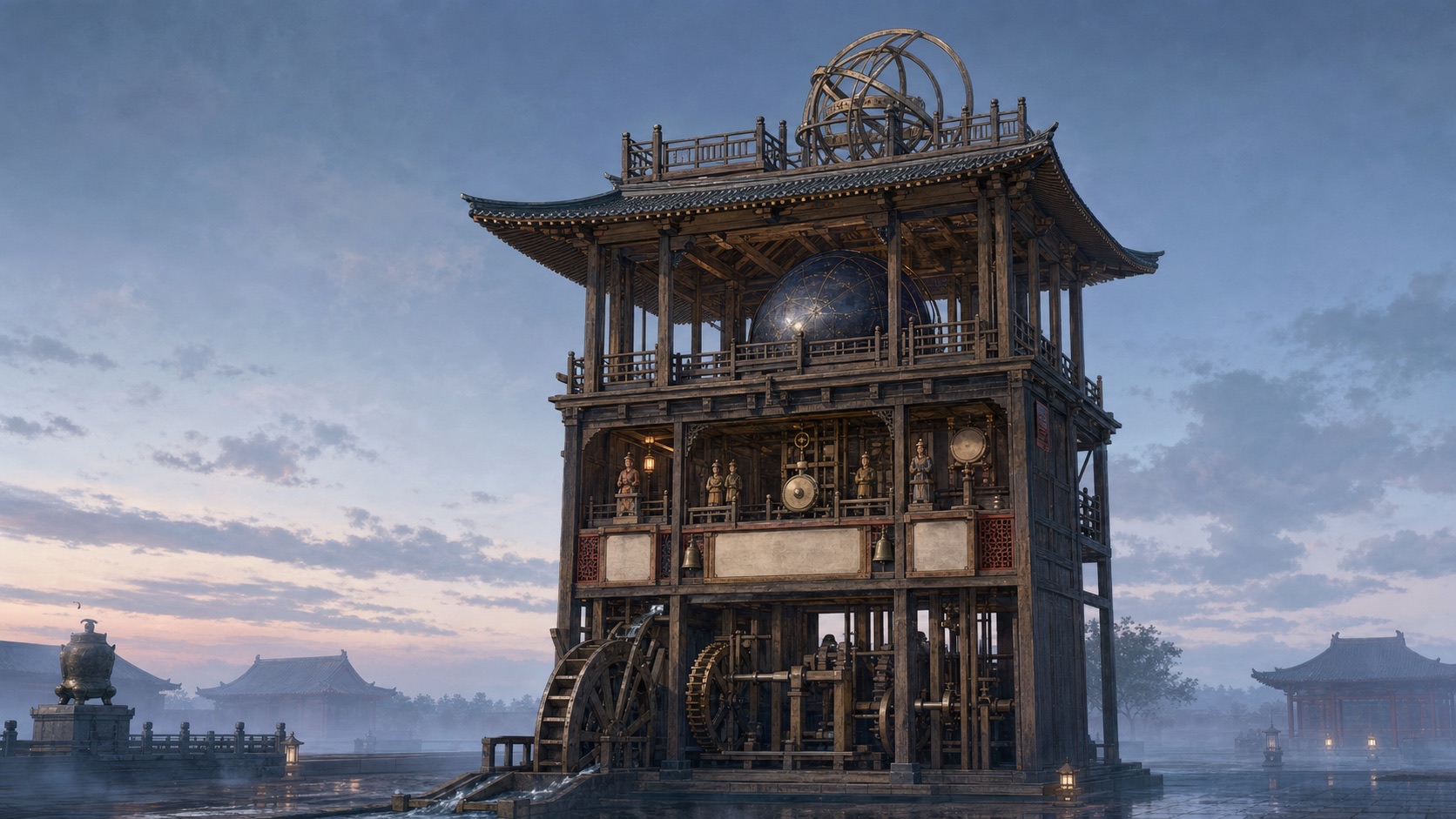
Su Song’s clock tower was a water-powered astronomical observatory and time-reporting machine built in Northern Song China. Approximately 12 meters high, it joined an armillary sphere for observation, a celestial globe representing the sky, hydropower and transmission mechanisms, and a multilevel facade where figures displayed and sounded the time.
In brief: The tower was more than a large clock. It observed the sky, modeled celestial motion, measured and displayed time, and announced intervals through bells, gongs, drums, plaques, and moving figures. Su Song documented its design in Xin Yixiang Fayao, making the project an unusually rich record of Song astronomy and mechanical engineering.
Contents
- Who was Su Song?
- What the tower contained
- How the tower reported time
- Why water powered an observatory
- What survives today
- What not to claim
- Frequently asked questions
Who was Su Song?
Su Song (苏颂, 1020–1101) was a Northern Song official and scholar associated with astronomy, calendrical work, natural knowledge, and technical administration. The Hong Kong Space Museum notes that he undertook the water-driven astronomical tower project at about age 70 and recorded the finished system in Xin Yixiang Fayao—“New Design for an Armillary Sphere and Celestial Globe” (Hong Kong Space Museum).
Large instruments of this kind were state projects. They required court authorization, astronomical expertise, mathematical work, materials, specialist artisans, maintenance, and a reason to keep official time. Calling the tower “Su Song’s” recognizes his leadership and documentation; it should not erase Han Gonglian and the wider team involved in its construction.
What the tower contained
The machine had three main vertical functions:
| Level | Main component | Purpose |
|---|---|---|
| Top | Armillary sphere | Observe positions in the sky using a coordinate framework |
| Middle | Celestial globe | Represent the starry sky and celestial movement |
| Lower structure | Power and time-reporting systems | Drive motion, display intervals, and announce time |
The armillary sphere was not decoration. It was an observing instrument. The celestial globe turned spatial knowledge into a model. The lower machinery supplied regular power and translated motion into public displays.
That combination is why the National Museum of Natural Science describes the system as an early automated observatory rather than merely a striking clock (NMNS reconstruction).
How the tower reported time
The museum’s working reconstruction gives the clearest public explanation of the five-tier time facade:
- Upper tier: figures alternately ring a bell on odd-numbered hours and strike a gong on even-numbered hours; another figure strikes a drum every 15 minutes.
- Second tier: figures appear with plaques showing the hour in a 24-hour reporting system.
- Third tier: figures display quarter-hour intervals.
- Fourth tier: a figure sounds 38 gong strikes across the night from dusk to dawn.
- Fifth tier: figures display the nighttime interval as the gong sounds.
These actions made abstract time multisensory. A viewer could see a plaque, hear a bell, distinguish a gong from a drum, and recognize that daytime and nighttime reporting used related but different structures.
The exact configuration described here belongs to the scholarly museum reconstruction. It should not be generalized to every Chinese astronomical clock or every phase of the original tower’s operation.
Why water powered an observatory
Water provided a controlled source of motion. Flow and a waterwheel could drive transmission through the system, while regulating mechanisms released motion in steps. The Hong Kong Space Museum compares part of the design to the escapement principle in later clocks, but the full tower belonged to its own water-driven astronomical tradition.
Hydropower linked three tasks:
- keeping a regular time reference;
- moving the celestial representation;
- triggering displays and sound at named intervals.
This integration was powerful because astronomy and timekeeping were administratively connected. A calendar depended on celestial observation and calculation; official time needed instruments and trained personnel; the tower made that relationship visible in one structure.
Water also created maintenance problems. Flow had to remain reliable, mechanical loads had to be balanced, and cold conditions could threaten water-based devices. Complex towers were remarkable precisely because they demanded an entire operating environment.
What survives today
The original tower did not survive. Su Song’s written and illustrated technical record, however, allowed modern scholars and museums to study and reconstruct it.
The National Museum of Natural Science in Taichung displays a full-scale working reconstruction based on research into Xin Yixiang Fayao. The museum describes it as the first true-to-scale working model of the tower. The Hong Kong Space Museum also provides a concise reconstruction of the tower’s history and functions.
Modern models are interpretations built from historical documentation. They are valuable evidence of how a mechanism can work, but they are not untouched pieces of the 11th-century original. A careful article names the reconstruction as a reconstruction.
What not to claim
Su Song’s tower is impressive without turning it into a competition slogan.
Avoid these shortcuts:
- “Su Song invented the world’s first clock.” Definitions of clock, astronomical mechanism, escapement, and automatic reporting differ.
- “Europe copied Su Song.” The evidence here does not establish a direct transmission line.
- “The tower was a perpetual-motion machine.” It required water power, calibration, labor, and maintenance.
- “It proved that every Chinese household had accurate mechanical time.” It was a major state instrument, not a domestic norm.
A stronger conclusion is narrower: the tower demonstrates that Northern Song specialists could integrate observation, celestial modeling, regulated water power, mechanical transmission, visual display, and acoustic time reporting at monumental scale.
Frequently asked questions
When was Su Song’s clock tower built?
The project belongs to the late 11th century under the Northern Song. Su Song documented its design and operation in Xin Yixiang Fayao. Museum summaries commonly place completion in the 1090s.
How tall was the tower?
The Hong Kong Space Museum describes it as approximately 12 meters high. Reconstructed dimensions depend on the scholarly model being discussed.
Was it a water clock?
It used water power and time-regulating mechanisms, but “water clock” alone understates it. It also contained astronomical observing and display instruments plus automated time reporting.
Did it have an escapement?
Museum explanations describe a mechanism similar in function to escapement in later clocks. It is safest to explain the specific stop-and-release role rather than claim identity with every later mechanical escapement.
Can the original tower be visited?
No original structure survives. Museums display researched reconstructions, including the full-scale working model at Taiwan’s National Museum of Natural Science.
A machine for seeing heaven and hearing time
Su Song’s tower made the order of the sky visible, mechanical, and audible. Its lasting significance lies not in a simplistic “first,” but in its integration: astronomical observation above, a moving sky model within, regulated water power below, and a facade that translated intervals into figures, plaques, bells, gongs, and drums. Place those reports within the full day using The 12 Shichen.