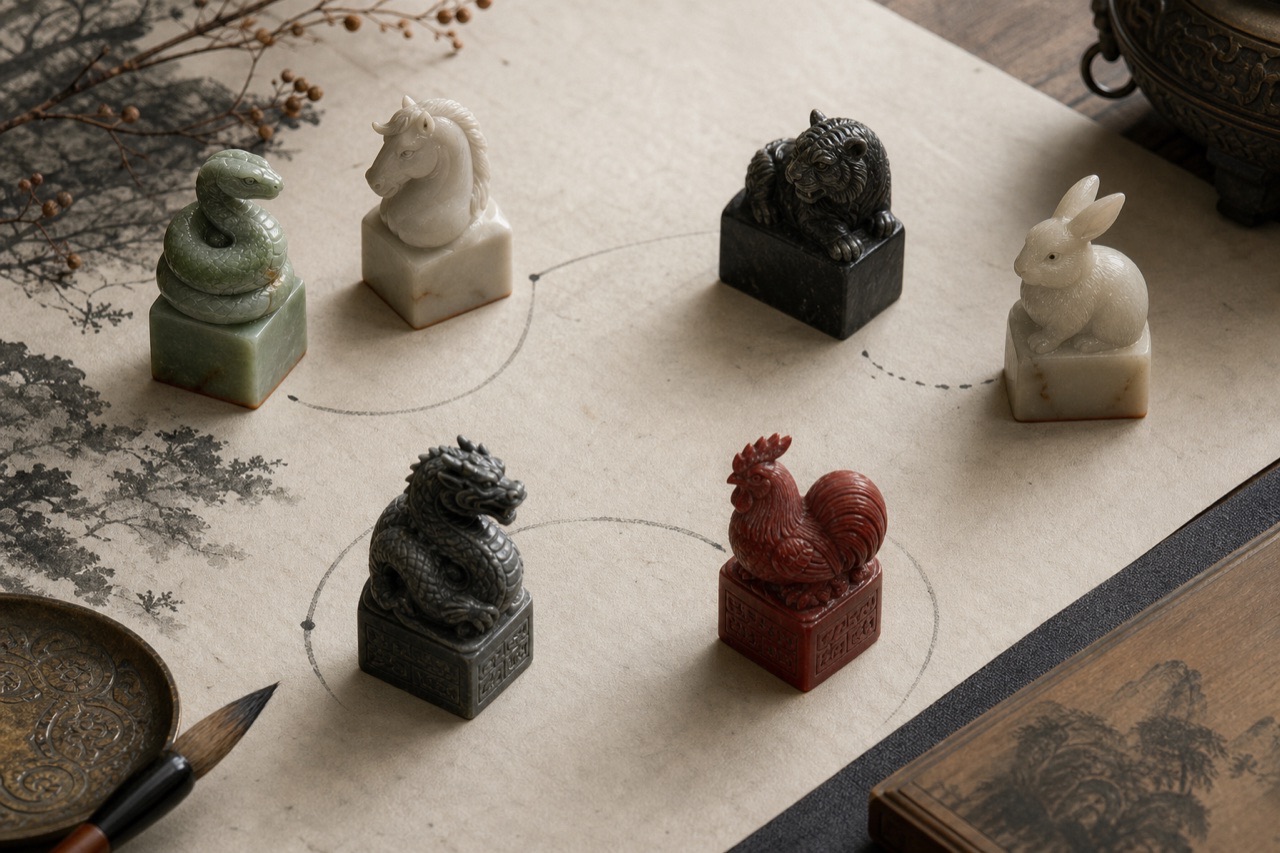
Chinese zodiac compatibility compares the 12 birth-year animals through traditional relationships between their Earthly Branches. Popular charts highlight six paired “harmonies,” four groups of three, and six opposing pairs. These patterns are part of a symbolic tradition—not a scientific test of love, friendship, or long-term relationship success.
In brief: Use a Chinese zodiac compatibility chart as a cultural conversation prompt. First confirm both people’s correct zodiac years, especially for January or February birthdays. Then read the pairings as traditional symbolism rather than a verdict about whether two people belong together.
Contents
- Chinese zodiac compatibility chart
- What the traditional pairings mean
- Why one birth-year animal is not a relationship forecast
- How to use compatibility responsibly
- Frequently asked questions
Chinese zodiac compatibility chart
The table below summarizes a commonly circulated Earthly Branch framework. “Harmony” does not mean guaranteed romance, and “clash” does not mean inevitable conflict.
| Pattern | Traditional groups | Careful modern reading |
|---|---|---|
| Six harmony pairs | Rat–Ox, Tiger–Pig, Rabbit–Dog, Dragon–Rooster, Snake–Monkey, Horse–Goat | A symbolic pairing of two complementary branches |
| Four harmony trios | Rat–Dragon–Monkey; Ox–Snake–Rooster; Tiger–Horse–Dog; Rabbit–Goat–Pig | Three branches grouped around a shared Five Phase pattern |
| Six opposing pairs | Rat–Horse, Ox–Goat, Tiger–Monkey, Rabbit–Rooster, Dragon–Dog, Snake–Pig | Contrasting positions in the 12-branch cycle |
There are 144 ordered combinations in a 12 × 12 compatibility grid, so a single list of “best matches” compresses a much larger tradition. Even within popular astrology, year-animal pairings are only the simplest layer.
Before using the chart, confirm each person’s animal with our Chinese zodiac birth-year guide. Birthdays before Lunar New Year normally remain in the previous zodiac year. You can also convert a Gregorian birth date to its Chinese lunar date with BaseToolbox.
What the traditional pairings mean
Six harmony pairs
The six pairings are often called liuhe (六合), literally “six combinations” or “six harmonies.” In branch-based interpretation, each animal is paired with one other animal. Modern compatibility pages often translate this as a “secret friend” or especially supportive match, but those phrases are simplified popular readings.
The six pairs are:
- Rat and Ox
- Tiger and Pig
- Rabbit and Dog
- Dragon and Rooster
- Snake and Monkey
- Horse and Goat
The important cultural point is structural: the animal stands for an Earthly Branch, and the relationship belongs to a branch system. It was not created as a modern personality quiz.
Four harmony trios
The four sanhe (三合) groups contain three branches each:
- Rat, Dragon, and Monkey — commonly associated with a Water configuration
- Ox, Snake, and Rooster — commonly associated with a Metal configuration
- Tiger, Horse, and Dog — commonly associated with a Fire configuration
- Rabbit, Goat, and Pig — commonly associated with a Wood configuration
These are sometimes described as “friendship triangles.” That is useful shorthand, but it leaves out the Five Phase and calendrical logic behind the grouping. Our Chinese zodiac elements guide explains why Wood, Fire, Earth, Metal, and Water are dynamic phases rather than five fixed personality boxes.
Opposing pairs and clashes
Six pairs sit opposite one another in the 12-branch sequence. Popular charts label them “clashes” and may turn that contrast into dramatic relationship warnings. A more measured reading is that the pair represents difference, tension, or movement within the symbolic system.
Real partners can handle differences well, while two people with a supposedly harmonious pair can still communicate poorly. A chart does not know anyone’s values, behavior, safety, responsibilities, or circumstances.
Why one birth-year animal is not a relationship forecast
The familiar zodiac animal is attached to the year branch. Traditional Four Pillars systems also use stems and branches for the month, day, and two-hour birth period. The Hong Kong Observatory documents how stems and branches were used for years, months, days, and shichen, creating the Eight Characters of a full chart (Heavenly Stems and Earthly Branches).
That does not make a full astrological chart scientifically predictive. It simply means that reducing the tradition to two year animals is a major simplification even on its own terms.
Recent research also separates belief effects from relationship outcomes. A 2026 study in the Journal of Economic Behavior & Organization found that zodiac compatibility beliefs affected observed matching patterns in China: pairings classified as “bad” appeared less often. However, the researchers reported no systematic effects of compatibility categories on the household outcomes they examined (Wu and Zha, 2026).
Psychology research offers another caution. In a study of 287 Western and Chinese participants, generic personality profiles could be accepted as personally accurate—the familiar Barnum effect—regardless of whether they were presented as Western or Chinese astrology (Rogers and Soule, 2009). Broad descriptions often feel specific because people naturally connect them to their own lives.
How to use compatibility responsibly
Step 1: confirm both zodiac years
Do not assign an animal from the Gregorian year alone. Compare the full birth date with Lunar New Year in that year. If a specific bazi practice uses Beginning of Spring instead, record that convention rather than mixing the two.
Step 2: identify the type of traditional relationship
Check whether the animals appear in a six-harmony pair, a three-animal group, an opposing pair, or none of these. “Neutral” is a normal result; the 12 animals were never designed to place every relationship into a best-or-worst ranking.
Step 3: translate symbolism into questions, not conclusions
Instead of “Are we compatible?”, ask:
- Where do our working styles naturally support each other?
- Which differences require clearer communication?
- How do we handle money, family, privacy, conflict, and future plans?
- Do both people feel respected and safe?
These questions make the traditional pattern reflective without surrendering real decisions to it.
Step 4: keep the chart away from high-stakes decisions
Do not use a zodiac pairing to excuse harmful behavior, pressure someone into a relationship, reject medical or financial advice, or override direct evidence about a person’s character. Cultural symbolism can add meaning; it cannot replace consent, judgment, or care.
Frequently asked questions
What Chinese zodiac signs are most compatible?
Popular charts highlight six pairs: Rat–Ox, Tiger–Pig, Rabbit–Dog, Dragon–Rooster, Snake–Monkey, and Horse–Goat. Four harmony trios are also widely used. These are traditional symbolic groupings, not evidence that a relationship will succeed.
What are the four Chinese zodiac compatibility trios?
The four groups are Rat–Dragon–Monkey, Ox–Snake–Rooster, Tiger–Horse–Dog, and Rabbit–Goat–Pig. They are traditionally connected with Water, Metal, Fire, and Wood configurations respectively.
What if our zodiac animals clash?
A clash is a symbolic opposition between two Earthly Branches, not a command to avoid someone. Treat it as a prompt to discuss differences. Communication, shared values, behavior, and safety matter far more than a birth-year label.
Can two people with the same Chinese zodiac animal be compatible?
Yes. A same-animal pairing is not automatically good or bad. The birth-year animal is a broad calendrical marker shared by millions of people, and it cannot measure an individual relationship.
Is Chinese zodiac compatibility scientifically accurate?
No reliable scientific evidence shows that birth-year animals predict relationship success. Research does show that compatibility beliefs can influence people’s choices, which is a social effect of belief rather than proof that the chart predicts outcomes.
Use the pattern without turning it into fate
Chinese zodiac compatibility is most valuable when it opens a conversation about Earthly Branches, Five Phase relationships, family customs, and the way beliefs shape choices. Confirm the correct animals, learn the traditional pattern, and then return the decision to the people actually living the relationship.