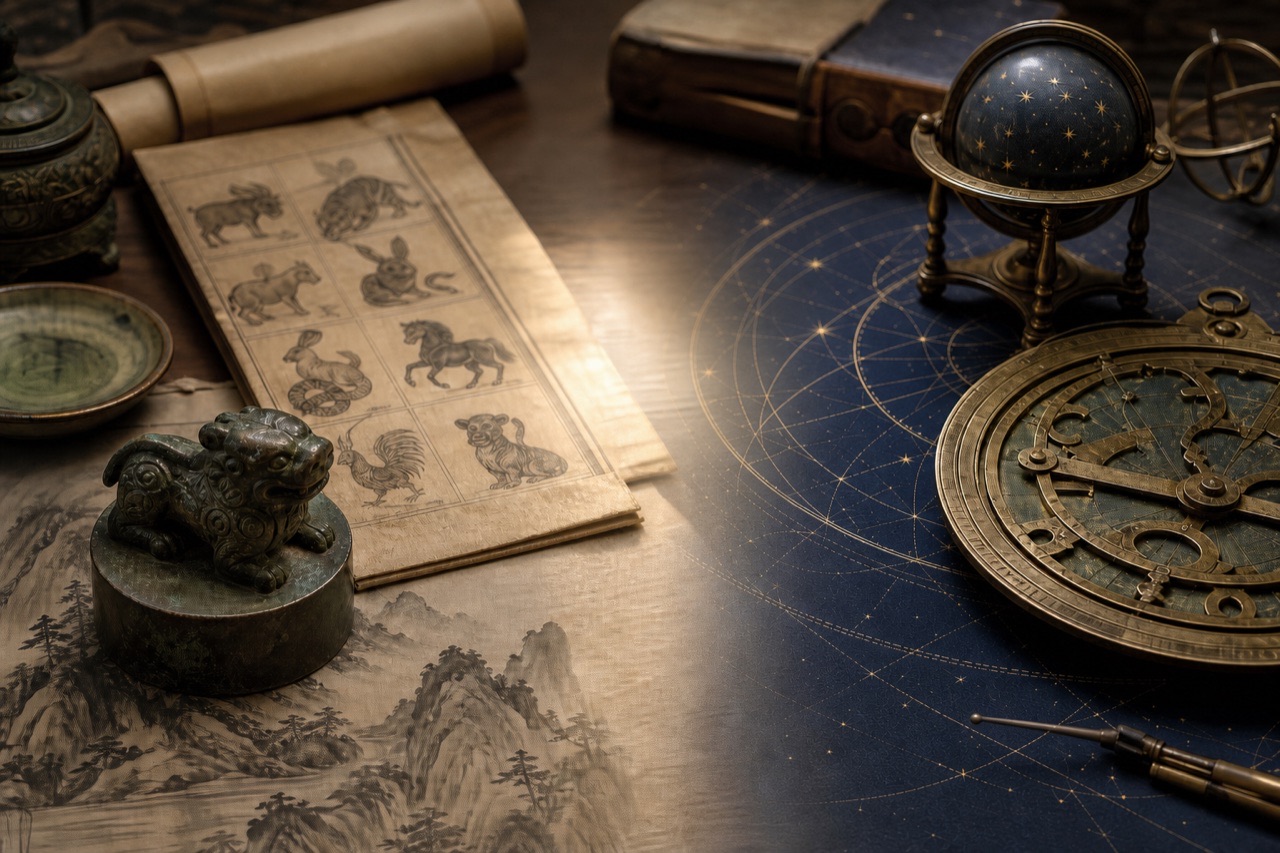
The main difference between the Chinese zodiac and Western zodiac is the cycle used for the familiar sign. A Chinese zodiac animal is usually assigned by a lunisolar calendar year that changes at Lunar New Year. A Western sun sign is assigned from the Sun’s position within a 12-part zodiac tied to the annual solar cycle.
In brief: Chinese zodiac = 12 animals repeating across years. Western sun signs = 12 signs repeating across one solar year. Both have deeper chart traditions, but their calendars, elements, symbols, and calculation methods are not interchangeable.
Contents
- Chinese zodiac vs. Western zodiac comparison
- How each sign is calculated
- Why both systems use 12
- Elements in the two traditions
- Can you have both a Chinese and Western sign?
- Frequently asked questions
Chinese zodiac vs. Western zodiac comparison
| Feature | Chinese zodiac | Western zodiac |
|---|---|---|
| Familiar sign | Birth-year animal | Sun sign |
| Basic cycle | 12 years | 12 signs across one year |
| Boundary | Usually Lunar New Year; some specialist systems use Beginning of Spring | Sign boundaries within the solar year |
| Main symbols | Rat through Pig, paired with Earthly Branches | Aries through Pisces, named after zodiac signs associated with the ecliptic |
| Element system | Five Phases: Wood, Fire, Earth, Metal, Water | Four classical elements: Fire, Earth, Air, Water |
| Expanded chart | Year, month, day, and hour stems and branches in systems such as Four Pillars | Sun, Moon, planets, houses, and angular relationships in a natal chart |
| Calendar issue to check | January and February birthdays | Birth date, time, and location for a full chart |
The comparison is between the popular entry points—a Chinese birth-year animal and a Western sun sign. Neither entry point represents everything found in its larger astrological tradition.
How each sign is calculated
Finding a Chinese zodiac animal
Start with the full Gregorian birth date. Find Lunar New Year in that Gregorian year:
- A birthday on or after Lunar New Year uses the new year’s animal.
- A birthday before Lunar New Year normally uses the previous animal.
- If a specialist system says it changes years at Lichun (Beginning of Spring), keep that convention separate.
This is why someone born on January 20, 1990, and someone born on February 20, 1990, may have different Chinese zodiac animals. The Gregorian year label alone is not enough.
For an exact date, use the BaseToolbox Gregorian to Chinese Lunar Calendar Converter, then follow our Chinese zodiac birth-year guide to apply the correct boundary.
The Hong Kong Observatory explains that the 12 animals correspond to the 12 Earthly Branches and records the animal cycle in Chinese literature from around 100 CE (The 12-Year Animal Cycle).
Finding a Western sun sign
The common Western horoscope sign uses the Sun’s position within the tropical zodiac. In Western culture, these are 12 sectors of 30 degrees each along the ecliptic, beginning at the vernal equinox (NASA Ames).
An everyday sun-sign lookup normally asks for month and day. A full natal chart also uses exact birth time and location to calculate the Moon, planets, houses, and angles. That is more detailed than a newspaper-style sun sign, just as Four Pillars is more detailed than one Chinese year animal.
Astronomical constellations and astrological signs should not be treated as identical. The International Astronomical Union defines constellations as bounded areas of the sky, and those areas are not 12 equal 30-degree sectors (IAU constellations).
Why both systems use 12
The shared number can make the systems look like translations of one another, but it comes from different structures.
In the Chinese calendar system, the 12 animals are attached to the 12 Earthly Branches. The branches also organize traditional two-hour periods, directions, months, and other calendrical units. The animal is a memorable symbol for a branch.
In the Western zodiac, the 12 signs divide the ecliptic—the Sun’s apparent annual path—into equal sectors. NASA’s educational material distinguishes those 30-degree astrological sectors from the modern astronomical constellations, which vary in size (NASA Night Sky Network).
So “Dragon” is not the Chinese equivalent of “Aries,” and “Horse” is not another name for “Sagittarius.” Any one-to-one pairing found online is a modern creative comparison, not a conversion between the traditions.
Elements in the two traditions
The element labels overlap only partly.
Chinese Five Phases
- Wood
- Fire
- Earth
- Metal
- Water
The Chinese term wuxing describes phases, movements, and relationships. A zodiac year combines an Earthly Branch animal with a Heavenly Stem carrying a phase and yin-yang quality. The 10 stems and 12 branches produce a 60-year cycle.
Western four elements
- Fire
- Earth
- Air
- Water
Western signs are grouped into four classical elements, with three signs in each group. This system does not contain Chinese Wood or Metal, and Chinese Five Phase relationships should not be used to “correct” a Western element.
The words Fire, Earth, and Water appear in both traditions, but shared English labels do not prove a shared method or meaning.
Can you have both a Chinese and Western sign?
Yes. The systems answer different cultural questions, so the same person can be a Chinese zodiac Horse and a Western zodiac Libra, for example. One label does not cancel the other.
A grounded way to read both is to keep their sources visible:
- Use the Chinese calendar boundary for the year animal.
- Use the Western zodiac method for the sun sign.
- Do not blend Five Phases with Western elements as if they were one table.
- Treat personality descriptions as symbolic readings, not psychological assessments.
A cross-cultural psychology study involving 287 participants found that acceptance of generic “Barnum” personality profiles was not determined by whether the profile was presented as Chinese or Western astrology (Rogers and Soule, 2009). That is a useful reminder that broad statements can feel personal in either system.
Frequently asked questions
Is the Chinese zodiac based on year or month?
The familiar Chinese zodiac animal is based on a lunisolar calendar year. Traditional systems can also assign branches to months, days, and two-hour periods, but the animal people commonly call “my Chinese zodiac sign” is the year animal.
Is the Western zodiac based on constellations?
Western astrological signs have historical links to zodiac constellations, but the tropical zodiac uses 12 equal 30-degree sectors beginning at the vernal equinox. Modern astronomical constellations have unequal boundaries and are not the same thing as those signs.
Are Chinese zodiac elements the same as Western elements?
No. The Chinese system uses Wood, Fire, Earth, Metal, and Water as Five Phases. The Western system groups signs under Fire, Earth, Air, and Water. Similar English words do not make the structures interchangeable.
Which zodiac is more accurate?
Neither Chinese nor Western zodiac personality categories are scientifically validated psychological assessments. Accuracy also cannot be compared when the two systems use different inputs and symbolic frameworks. Read them as cultural traditions, not diagnostic tools.
Why is my Chinese zodiac different on two websites?
One site may have used January 1, another Lunar New Year, and another Beginning of Spring. For the familiar cultural animal, use Lunar New Year and an exact birth date. A responsible result should state its cutoff convention.
Two systems, two different calendars
Chinese zodiac and Western zodiac traditions both use 12-part symbolic languages, but they organize time differently. Keep the year animal, sun sign, calendar boundary, and element system in their proper contexts. Comparison becomes more interesting—and more accurate—when it does not flatten one tradition into the other.