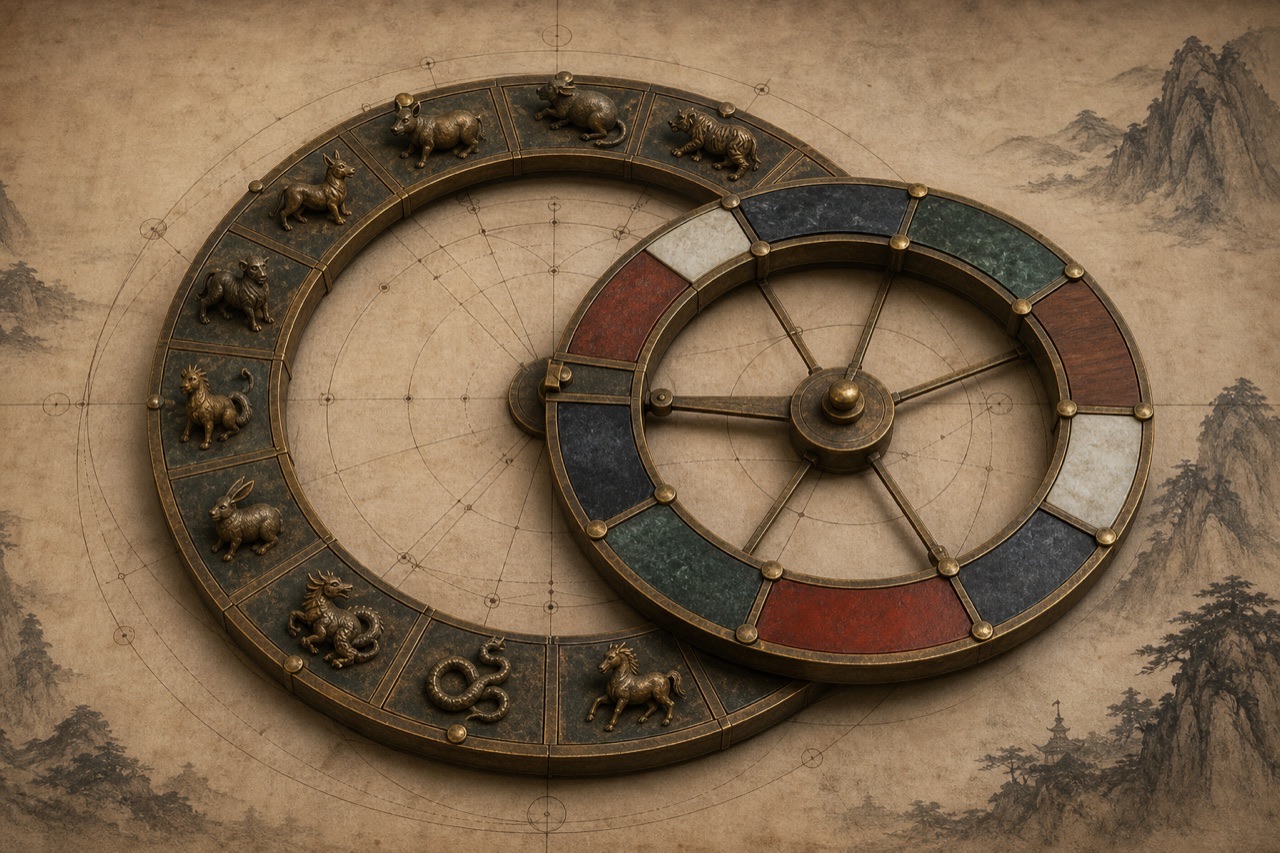
The Chinese zodiac works by pairing two repeating sequences: 10 Heavenly Stems and 12 Earthly Branches. Each branch is associated with one of the 12 zodiac animals. Because the two lists advance together and realign after 60 steps, the complete calendar cycle lasts 60 years—not merely 12.
In brief: The animal tells you the Earthly Branch of a zodiac year. The Heavenly Stem adds yin or yang and one of the Five Phases. A year such as 2026 is therefore not just Horse; it is Bing-Wu, commonly described in English as a yang Fire Horse year.
Contents
- The Chinese zodiac in four layers
- Why the cycle lasts 60 years
- How to find your Chinese zodiac year
- Worked example: the 2026 Fire Horse
- What the zodiac animal leaves out
- Frequently asked questions
The Chinese zodiac in four layers
Layer 1: the 12 Earthly Branches
The branches form this fixed order:
| Number | Branch | Animal |
|---|---|---|
| 1 | Zi (子) | Rat |
| 2 | Chou (丑) | Ox |
| 3 | Yin (寅) | Tiger |
| 4 | Mao (卯) | Rabbit |
| 5 | Chen (辰) | Dragon |
| 6 | Si (巳) | Snake |
| 7 | Wu (午) | Horse |
| 8 | Wei (未) | Goat |
| 9 | Shen (申) | Monkey |
| 10 | You (酉) | Rooster |
| 11 | Xu (戌) | Dog |
| 12 | Hai (亥) | Pig |
The Hong Kong Observatory notes that the 12-year animal cycle corresponds to these 12 branches and appears in surviving Chinese literature from around 100 CE (The 12-Year Animal Cycle).
The animals make the sequence memorable, but the branches are the underlying calendrical labels. They also name the 12 traditional two-hour periods.
Layer 2: the 10 Heavenly Stems
The stems also have a fixed order:
- Jia (甲)
- Yi (乙)
- Bing (丙)
- Ding (丁)
- Wu (戊)
- Ji (己)
- Geng (庚)
- Xin (辛)
- Ren (壬)
- Gui (癸)
Each pair of stems carries one of the Five Phases:
| Stems | Yin-yang order | Phase |
|---|---|---|
| Jia, Yi | yang, yin | Wood |
| Bing, Ding | yang, yin | Fire |
| Wu, Ji | yang, yin | Earth |
| Geng, Xin | yang, yin | Metal |
| Ren, Gui | yang, yin | Water |
This is why one phase appears for two consecutive zodiac years. The Chinese zodiac elements guide provides a recent year lookup and explains the phase meanings in more detail.
Layer 3: one stem plus one branch
The first pairing is Jia-Zi: the first stem with the first branch. The next year is Yi-Chou, then Bing-Yin. Both lists move forward one place every year, wrapping to the beginning when each reaches its end.
The Hong Kong Observatory publishes all 60 Gan-Zhi pairings from Jia-Zi through Gui-Hai (Heavenly Stems and Earthly Branches).
Layer 4: the lunisolar year boundary
The familiar cultural zodiac animal normally changes at Lunar New Year, not January 1. This means a Gregorian calendar year can contain parts of two zodiac years.
Some bazi and fortune-calculation traditions use Lichun, or Beginning of Spring, as the year boundary. The Hong Kong Observatory distinguishes the official Chinese calendar year change at Lunar New Year from that specialist convention (What year is it today?).
Why the cycle lasts 60 years
The mathematical reason is the least common multiple of 10 and 12:
- The stem list returns to its beginning every 10 years.
- The branch and animal list returns every 12 years.
- Both return to their starting positions together after 60 years.
It may look as though 10 stems × 12 branches should produce 120 combinations. It does not, because the lists advance together rather than pairing every stem with every branch. Yang stems pair with yang branches, and yin stems pair with yin branches, leaving 60 valid sequential pairings.
This creates five versions of every animal across one complete cycle. For example, Horse years move through Wood Horse, Fire Horse, Earth Horse, Metal Horse, and Water Horse before returning to the same full stem-branch pairing after 60 years.
How to find your Chinese zodiac year
Step 1: start with the full Gregorian birth date
Do not begin with a modulo formula based only on the printed year. That shortcut fails for birthdays before Lunar New Year.
Step 2: convert or check the calendar boundary
Use the BaseToolbox Gregorian to Chinese Lunar Calendar Converter to see the corresponding Chinese lunar year, month, and day. The conversion runs locally in the browser. Then compare the result with the Lunar New Year boundary described in our Chinese zodiac sign guide.
Step 3: identify the Earthly Branch animal
Find the animal attached to that zodiac year. The sequence repeats every 12 years, so 1990, 2002, 2014, and 2026 are all Horse years after their respective Lunar New Year dates.
Step 4: identify the Heavenly Stem
Look up the year’s Gan-Zhi name. The stem supplies the phase and yin-yang quality. This turns a generic animal into a more specific pairing such as Metal Horse, Water Horse, or Fire Horse.
Worked example: the 2026 Fire Horse
The 2026 Lunar New Year begins on February 17, 2026. Under the Lunar New Year convention:
- February 16, 2026 is still in the preceding Wood Snake year.
- February 17, 2026 begins the new Horse year.
- The Gan-Zhi name is Bing-Wu (丙午).
- Bing is yang Fire; Wu is the Horse branch.
- The result is commonly called a Fire Horse year in English.
The previous Bing-Wu year was 1966, exactly 60 years earlier. Horse itself returned more often—in 1978, 1990, 2002, and 2014—but those years used different Heavenly Stems.
What the zodiac animal leaves out
A birth-year animal is a useful cultural identifier, but it is not the whole traditional chart. Stems and branches have also been used to record:
- the year
- the month
- the day
- the two-hour birth period
Together, four stem-branch pairs form the “Eight Characters” used in Four Pillars systems. The year contributes only two of those eight characters.
That is why a site claiming to reveal a complete personality, medical condition, financial future, or relationship outcome from one animal is overstating the method. The zodiac is more responsibly explored through calendar history, festivals, art, family customs, and symbolic interpretation.
For the animals themselves, continue with our guide to all 12 Chinese zodiac signs. For traditional relationship groupings, see Chinese zodiac compatibility.
Frequently asked questions
Why are there 12 Chinese zodiac animals but a 60-year cycle?
The 12 animals follow the Earthly Branches, while 10 Heavenly Stems add yin-yang and Five Phase information. The two sequences advance together and return to their starting pair after 60 years.
Does the Chinese zodiac start on January 1?
No. The familiar zodiac animal normally changes at Lunar New Year. January and February birthdays need an exact date check because they may remain in the previous zodiac year.
Is the Chinese zodiac lunar or solar?
“Lunisolar” is more precise. Traditional months follow lunar phases, while leap-month and solar-term structures help keep the calendar aligned with the seasonal solar year.
Why do some websites use February 4?
They may be using Lichun, Beginning of Spring, as a Gan-Zhi boundary for a specialist bazi convention. For the familiar cultural birth-year animal, use Lunar New Year unless the source explicitly names another method.
Does every animal combine with every element?
Across the 60-year sequence, each animal appears with all five phases, one at a time. A specific stem-branch pairing—such as Bing-Wu Fire Horse—returns every 60 years.
The animal is the doorway, not the whole system
Understanding how the Chinese zodiac works turns a list of 12 animals into a structured calendar: 10 stems, 12 branches, Five Phases, yin and yang, and a 60-year cycle. Start with the correct birth-date boundary, then add the stem and branch before interpreting the cultural symbolism.