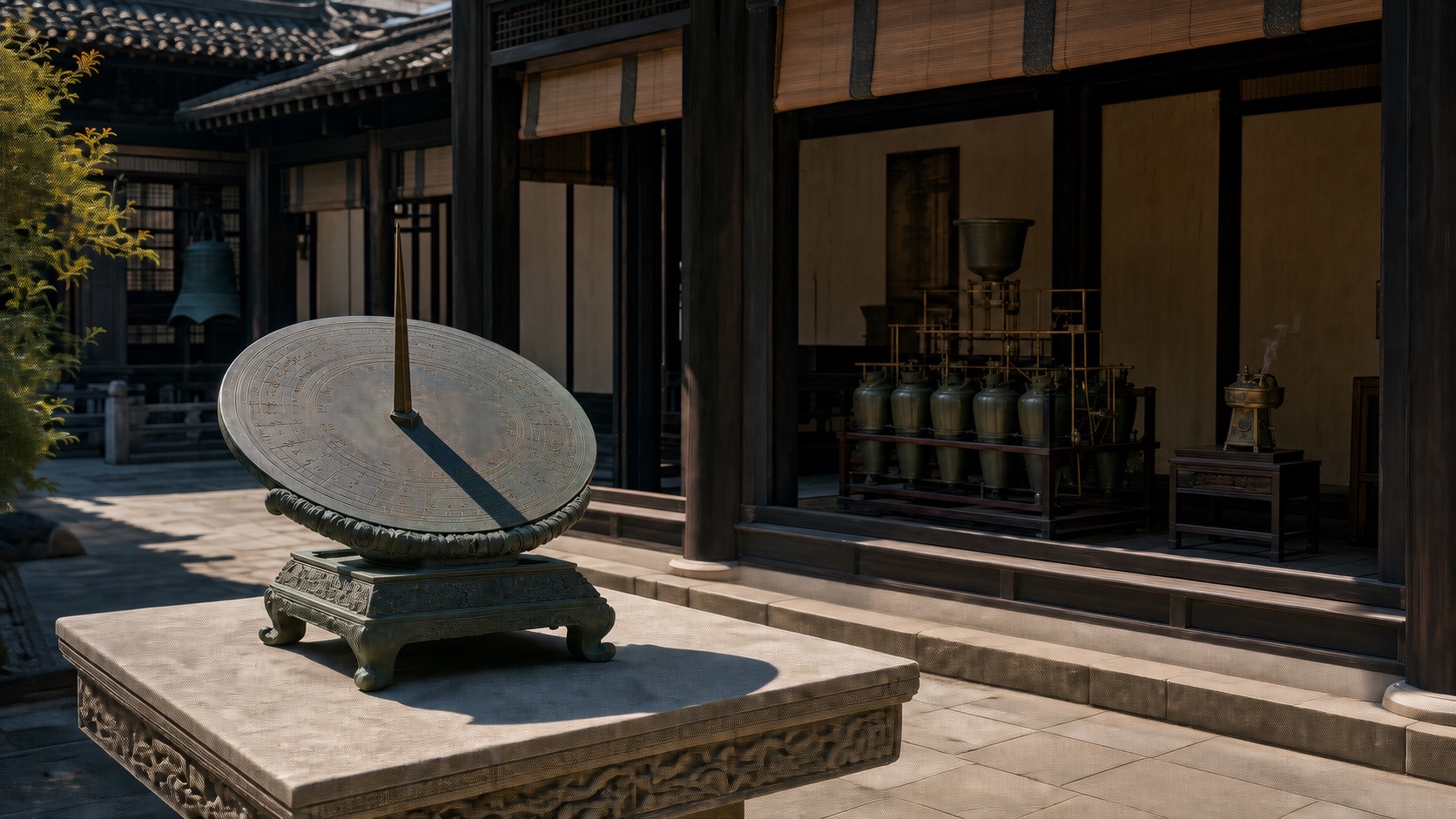
Ancient China told time through a system of observation, measurement, display, and public announcement. Gnomons and sundials followed the Sun; water clocks measured controlled flow; incense marked duration in some settings; astronomical clock towers joined water power, gearing, display, and sound; and officials or watchmen made time public with placards, bells, drums, gongs, and cymbals.
In brief: There was no single “ancient Chinese clock.” Different tools solved different problems. A sundial worked in daylight and clear weather, a clepsydra could operate indoors at night, an incense clock made duration visible through burning material, and public sound carried time to people who did not own an instrument.
Contents
- Six ways to make time visible
- Gnomons and sundials
- Water clocks and official timekeeping
- Incense clocks
- Astronomical and mechanical clocks
- Bells, drums, and public time
- Frequently asked questions
Six ways to make time visible
| Method | What changes | Main strength | Main limitation |
|---|---|---|---|
| Gnomon | Length and direction of a shadow | Connects time with solar observation | Needs sunlight and interpretation |
| Sundial | Shadow position on a marked surface | Direct visible reading | Weather, season, and placement matter |
| Water clock | Water level or flow | Works indoors and at night | Flow must be regulated; cold can interfere |
| Incense clock | A calibrated path burns away | Portable material duration | Fuel, airflow, and setup affect the burn |
| Astronomical clock | Water power drives displays and reporting | Combines observation, motion, and time signals | Complex to build and maintain |
| Bells, drums, placards | People or mechanisms announce a period | Shares time across a community | Depends on an institution and reporting rule |
The distinction between measuring and announcing matters. A water clock might keep the underlying time while an official changes a placard or beats an instrument. The sound is the interface, not necessarily the measuring engine.
Gnomons and sundials
A gnomon is the upright element whose shadow changes as the Sun moves. It can help determine noon, compare shadow lengths, and support calendrical or astronomical observation. A sundial adds a marked surface so the shadow indicates time more directly.
The Palace Museum defines the sundial as an ancient device that used changes in the length and direction of the Sun’s shadow to determine time (Palace Museum sundial). At a palace, the object also carried political symbolism: ordered time, ordered space, and imperial authority could appear together.
Solar methods have obvious limits. Clouds obscure the shadow. Night removes it. The apparent path of the Sun changes with season and latitude. A correctly designed dial must fit its location and orientation; one cannot simply place any decorative dial anywhere and expect an accurate clock.
Water clocks and official timekeeping
A water clock, or clepsydra, measures time through a regulated change in water level. A simple form lets water drip from an upper vessel into a lower vessel. A float and marked placard can rise with the level, turning flow into a readable scale.
Research on late medieval Chinese astronomical institutions describes earlier two-vessel versions and a four-vessel water clock made in Guangzhou in 1316. Adding vessels could stabilize pressure and improve the regularity of flow. Water clocks could operate day or night, although they needed protection from freezing in winter (Journal of Chinese History).
Water-clock work was institutional. Timekeepers maintained the instrument, watched its indicators, changed signs, and announced periods. The device did not eliminate skilled labor; it organized it.
Read How Chinese Water Clocks Worked for vessel design, calibration, staffing, and historical time scales.
Incense clocks
Incense can turn time into a trail of ash. In a seal-type clock, powdered incense is pressed into a measured groove. As the ember travels along the path, the remaining and burned sections indicate duration.
Museum objects show that these were engineered containers, not simply loose sticks. A Chinese incense clock in the Horniman Museum includes trays, an incense seal, a tamper plate, and a pierced cover. The cover reduces the effect of drafts that could accelerate burning (Horniman Museum). The Smithsonian also holds a compact Chinese incense clock measuring 10.3 by 9.2 by 9.2 centimeters (National Museum of American History).
The surviving object does not justify every internet story told about incense clocks. Claims about different fragrances announcing exact hours, elaborate alarms, or universal domestic use need their own evidence. Our Incense Clock guide stays close to museum-supported form and function.
Astronomical and mechanical clocks
The most spectacular timekeeper in this collection is Su Song’s Northern Song water-powered armillary-sphere and celestial-globe tower. It combined astronomical observation, a rotating representation of the sky, water-powered transmission, time display, and sound-producing figures.
The reconstructed tower at Taiwan’s National Museum of Natural Science has a five-tier reporting structure: figures ring a bell or gong on alternating hours, a drum marks 15-minute intervals, plaques show hours and quarter-hours, and lower tiers report the night (museum reconstruction). This was closer to an automated observatory than to a household clock.
From the late Ming and early Qing onward, European mechanical clocks entered China in growing numbers. Qing court collections included imports, works made in Guangzhou and Suzhou, and clocks produced by imperial workshops. These objects could report time, play music, and animate figures, flowers, birds, or animals (Palace Museum Clock Gallery).
The history is not a straight line from “primitive” to “modern.” Different systems valued astronomical integration, seasonal adjustment, public reporting, craft spectacle, portability, or mechanical regularity.
Bells, drums, and public time
Most people did not need to inspect the water level in an astronomical bureau. Time reached them through public signals.
Late medieval official timekeepers could announce double-hours by beating drums and cymbals. Placards displayed named periods. Night watchmen later walked routes and used patterned sounds to report watches. A Qing watch clock could automate the Chinese geng system and adjust it to seasonal night length.
This makes timekeeping social infrastructure:
- an instrument or observation establishes a reference;
- trained people maintain and interpret it;
- signs and sounds translate it into a public message;
- gates, duties, rituals, watches, and work respond to that message.
Our guides to night watchmen and time announcements in Chinese cities examine that public layer separately.
Frequently asked questions
What was the most common ancient Chinese clock?
There was no single answer across all periods and settings. Official institutions often relied on practical instruments such as gnomons and water clocks, while communities received time through public signs and sounds.
Could water clocks work at night?
Yes. Unlike a sundial, a water clock did not need sunlight. It did require regulated flow, maintenance, and protection against freezing conditions.
Did China have mechanical clocks before European clocks arrived?
Chinese engineers built complex water-powered astronomical mechanisms, including Su Song’s tower. Later European spring- or weight-driven mechanical clocks entered a different technological and court-craft context.
Were incense clocks accurate?
They could mark calibrated duration, but burn rate depends on material, packing, airflow, humidity, and design. Treat them as material timekeepers, not modern precision clocks.
How did ordinary people know the time?
Environmental cues, work routines, temple or civic sounds, official announcements, and night watches could all communicate time without a personal clock.
Time was an ecosystem
Ancient Chinese timekeeping was not one invention waiting to become a wristwatch. It was an ecosystem linking sky, water, fire, instruments, skilled labor, administration, sound, and daily life. Start with the device that answers your question, then return to The 12 Shichen to see which daily periods those systems reported.