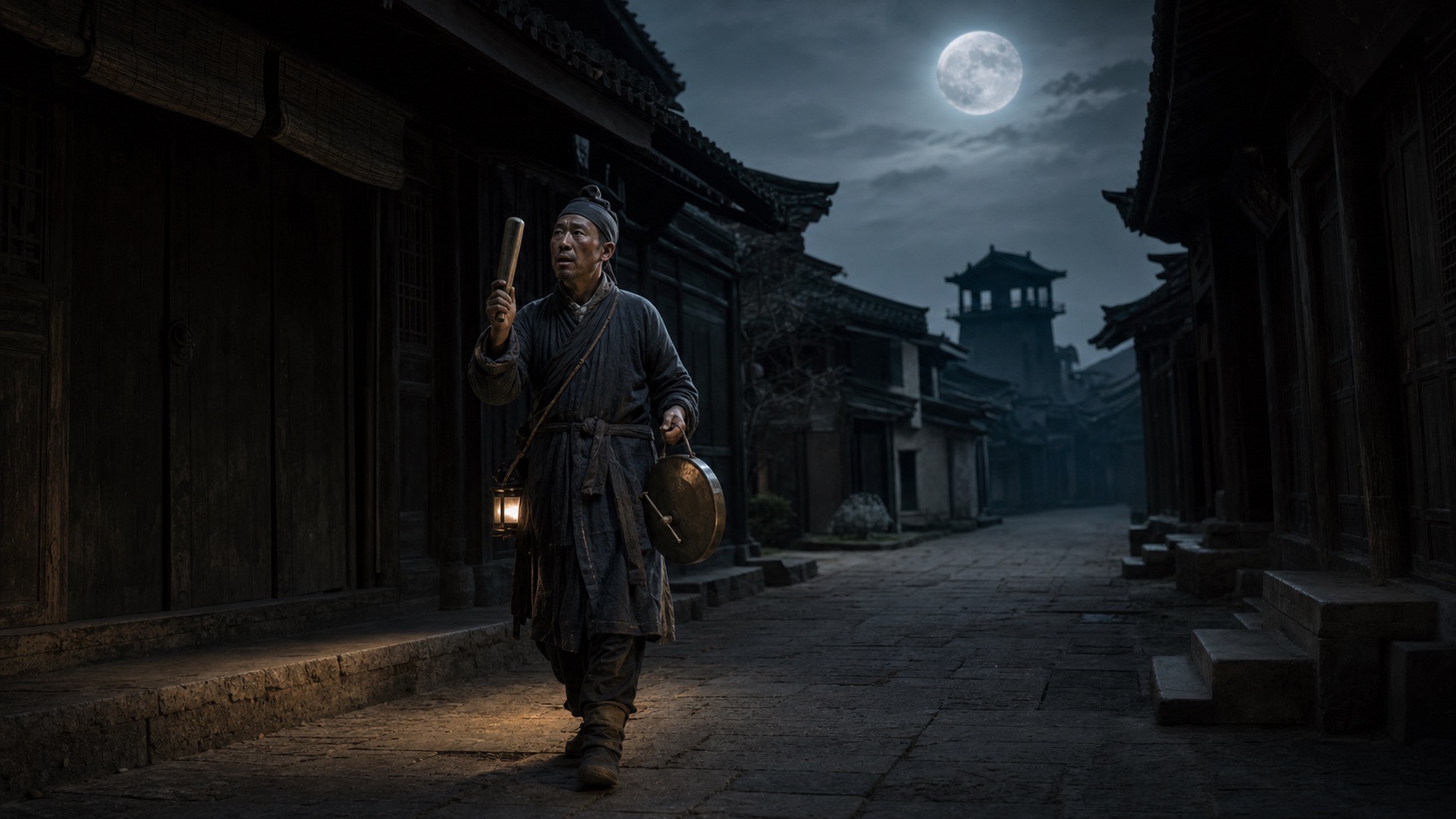
A Chinese night watchman was often called a gengfu (更夫): literally, a worker associated with the night watches. Rather than owning the master clock, the watchman’s essential public function was to carry a recognizable time signal through a compound, neighborhood, or street. Struck sound made the invisible progress of the night audible to people without personal timepieces.
In brief: Gengfu were part of timekeeping infrastructure. A watch system needed an authoritative reference, a schedule, recognizable sound patterns, and workers to announce them. Their duties could overlap with patrol, fire awareness, gates, or security in particular places, but no single job description fits every Chinese city and dynasty.
Contents
- What gengfu means
- Why public time needed workers
- The sound of a watch
- Timekeeping, authority, and ordinary listeners
- What historical dramas simplify
- Frequently asked questions
What gengfu means
Geng (更) is a watch or a change of watch; fu (夫) identifies a male worker in this occupational term. “Night watchman” is the clearest general translation. “Time crier” captures the reporting function, while “patrolman” may fit only when the local job actually included patrol duties.
The title should not be mistaken for one centrally standardized profession across two thousand years. Nighttime reporting could be organized by a court office, a city institution, a military unit, a household or compound, or local personnel. Instruments and signals varied as well.
The stable idea is functional: somebody converted a time reference into a public event.
Why public time needed workers
Before portable clocks became ordinary possessions, knowing the hour was an information problem. A water clock might be accurate enough for an institution, but the water level inside a timekeeping office was invisible to most residents. A sundial could not serve the night. Even a mechanical clock needed a display or signal that reached its audience.
The chain looked something like this:
- An institution maintained a reference, such as a clepsydra or later clock.
- A trained reader observed a scale, figure, or mechanism.
- The indicated period was converted into a placard, drum, gong, bell, cymbal, or other signal.
- A watchman or messenger carried, repeated, or localized the announcement.
- Listeners adjusted work, rest, guard changes, travel, or ritual schedules.
This is why an “ancient clock” should not be studied only as an object. The people who filled vessels, protected water from freezing, checked flow, read indicators, struck instruments, and walked routes were part of the clock’s real operation.
For the instruments behind that chain, start with How Ancient China Told Time.
The sound of a watch
The familiar image is a worker moving through dark streets with a clapper or gong. It conveys two practical features of acoustic time.
First, sound travels around corners and through darkness. A visible dial requires line of sight and light; a repeated beat can reach a dispersed audience. Second, patterns can encode position. Listeners do not need to see a number if they recognize the signal associated with a watch.
However, “the Chinese watchman always struck this exact pattern” is too broad. The sounding instrument, beat sequence, route, and audience could depend on institution and locality. A court timekeeping section and a neighborhood patrol did not necessarily operate alike.
The five-watch system itself could also be seasonal. A Qing mechanical watch clock preserved by the Palace Museum adjusted watch timing through the 24 solar terms. Read Why the Five Watches Changed with the Seasons before converting every report into a fixed two-hour interval.
Timekeeping, authority, and ordinary listeners
Research on the history of gengfu treats public time as a relationship among technology, political authority, and everyday life. That framing matters. Announcing time can coordinate a population, but it also identifies whose schedule counts as official.
An institution might determine the reference. Skilled staff interpreted it. Watch workers projected it into shared space. Most listeners participated by recognizing and responding to the sound. Public time was therefore both a service and an expression of organization.
Accounts of official timekeeping in medieval China describe a wider reporting apparatus: water clocks, displayed placards, drums, cymbals, and even an official imitating a rooster near dawn. Such examples should be attributed to their documented setting rather than turned into an unchanging national custom.
What historical dramas simplify
Drama needs immediate signals. A lone watchman calling the watch gives viewers darkness, danger, and a timestamp in seconds. Real infrastructure was messier.
- The person in the street may not have controlled the master reference.
- The announcement could belong to a relay of readers, officials, and signalers.
- Watch lengths could change seasonally.
- Duties and instruments varied.
- A literary “third watch” can create atmosphere without defining an exact minute.
This does not make the dramatic image false. It makes it a compressed symbol of a larger system. For translation help, use Shichen in Wuxia, Dramas, and Games.
Frequently asked questions
What is a gengfu?
A gengfu is a night-watch worker who helps announce the progress of the watches, commonly translated as night watchman.
What did Chinese night watchmen carry?
Visual and textual traditions associate watch reporting with struck instruments such as gongs, drums, clappers, or other sound makers. The exact equipment depended on the setting.
Were night watchmen also guards?
Sometimes duties could overlap with patrol or security, but “watchman” here first refers to the night-watch and time-reporting role. Do not assume an identical police function everywhere.
How did they know when to strike?
They could receive or relay time based on an institutional clock, clepsydra, schedule, or local signal system. The public announcer was one part of a longer timekeeping chain.
Did every town have the same watch calls?
There is no good basis for one universal pattern across all periods and regions. Use a named source when describing a particular sequence.
Timekeeping had footsteps
The gengfu reminds us that time was not only calculated in an observatory or contained inside a vessel. It had to leave the instrument, enter the street, and reach human ears. Footsteps, repeated sound, maintenance, and institutional authority turned a measured interval into public knowledge.
Next, follow the whole reporting chain in How Ancient Chinese Cities Announced the Time, then place its night watches within The 12 Shichen.