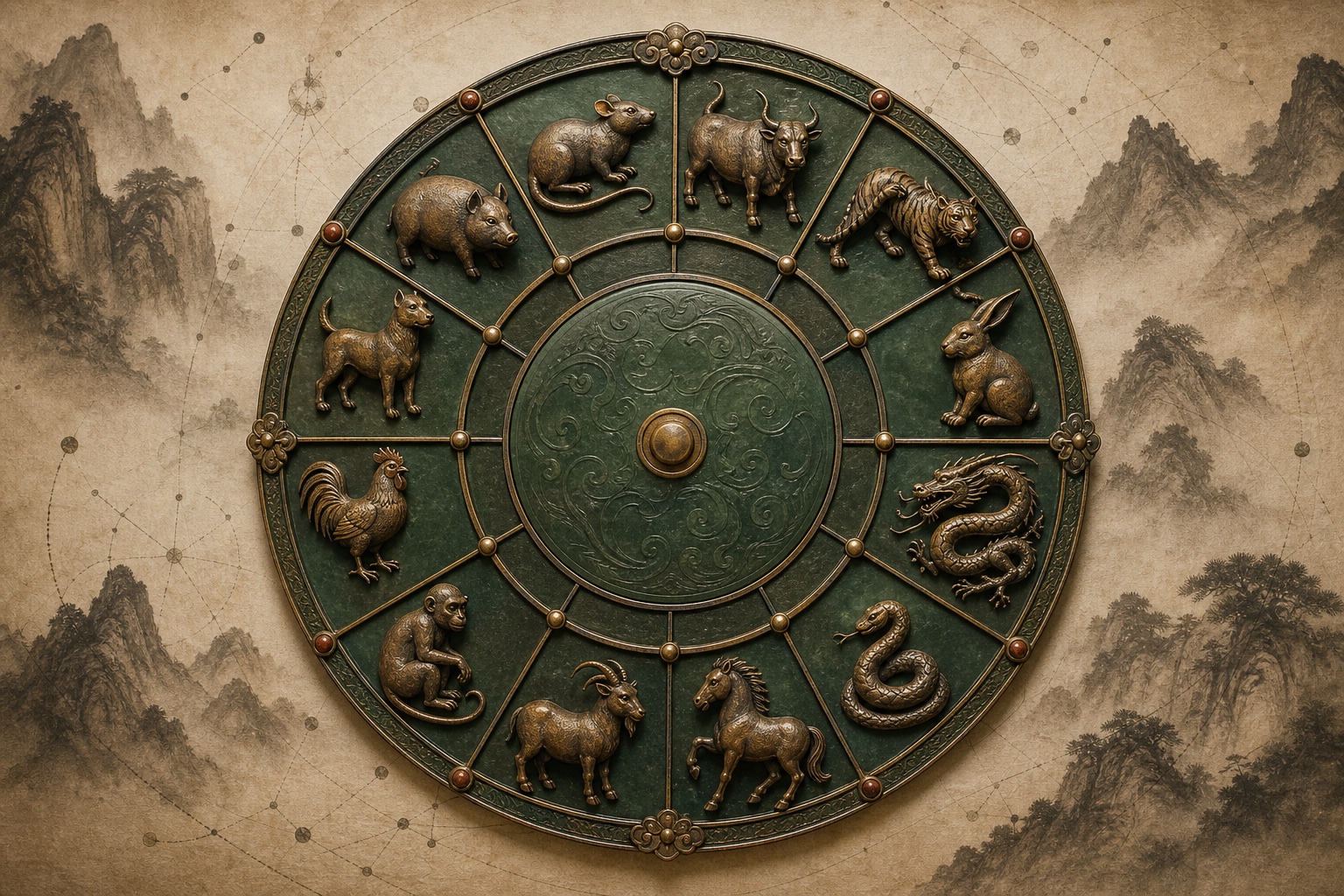
The 12 Chinese zodiac signs are Rat, Ox, Tiger, Rabbit, Dragon, Snake, Horse, Goat, Monkey, Rooster, Dog, and Pig. Each animal corresponds to one of the 12 Earthly Branches and returns every 12 years. Combined with the 10 Heavenly Stems and Five Elements, the system forms a 60-year naming cycle rather than a simple collection of personality types.
In brief: Your zodiac animal usually changes at Lunar New Year, not January 1. The signs are a calendrical and cultural system first; familiar personality and compatibility meanings are interpretations, not scientific predictions.
Contents
- The 12 Chinese zodiac signs in order
- How the Chinese zodiac cycle works
- Common meanings of the 12 animals
- The Five Elements and the 60-year cycle
- Chinese zodiac signs in history and art
- Frequently asked questions
The 12 Chinese zodiac signs in order
| Order | Animal | Earthly Branch | Example years after Lunar New Year |
|---|---|---|---|
| 1 | Rat | Zi (子) | 1984, 1996, 2008, 2020 |
| 2 | Ox | Chou (丑) | 1985, 1997, 2009, 2021 |
| 3 | Tiger | Yin (寅) | 1986, 1998, 2010, 2022 |
| 4 | Rabbit | Mao (卯) | 1987, 1999, 2011, 2023 |
| 5 | Dragon | Chen (辰) | 1988, 2000, 2012, 2024 |
| 6 | Snake | Si (巳) | 1989, 2001, 2013, 2025 |
| 7 | Horse | Wu (午) | 1990, 2002, 2014, 2026 |
| 8 | Goat | Wei (未) | 1991, 2003, 2015, 2027 |
| 9 | Monkey | Shen (申) | 1992, 2004, 2016, 2028 |
| 10 | Rooster | You (酉) | 1993, 2005, 2017, 2029 |
| 11 | Dog | Xu (戌) | 1994, 2006, 2018, 2030 |
| 12 | Pig | Hai (亥) | 1995, 2007, 2019, 2031 |
The “example years” assume a birthday on or after Lunar New Year. People born in January or February should use our Chinese zodiac birth-year guide to check the exact cutoff.
Need the exact traditional date? Use the BaseToolbox Gregorian to Chinese Lunar Calendar Converter. It converts the date locally in your browser; our birth-year guide explains how to turn that calendar result into the correct zodiac animal.
How the Chinese zodiac cycle works
The animal cycle is a mnemonic and symbolic layer attached to the 12 Earthly Branches. Those branches organize more than years: they also appear in traditional month, day, direction, and time systems. In daily English, however, “Chinese zodiac sign” usually means the animal associated with a person’s birth year.
The Hong Kong Observatory traces the animal cycle in surviving literature to around the first century CE and lists the same conventional sequence used today (The 12-Year Animal Cycle). The cycle does not reset at the start of a Gregorian decade, and no animal is inherently outside the system; all 12 have a fixed place in the rotation.
For a step-by-step explanation of how the 10 stems and 12 branches advance together, read How the Chinese Zodiac Works.
Popular stories explain the order through a race overseen by the Jade Emperor. Versions differ in how the Rat crosses the river, why the Cat is absent, and how the animals finish. These stories are culturally important, but they should not be confused with documentary evidence for the calendar’s origin.
Common meanings of the 12 animals
The descriptions below summarize widespread modern associations. They are not fixed diagnoses of everyone born in a year, and meanings vary by region, family, era, and source.
Rat
The Rat is often associated with alertness, resourcefulness, and the ability to work with limited means. As the first animal, it can also suggest beginnings and quick adaptation.
Ox
The Ox commonly represents steadiness, labor, patience, and reliability. Agricultural life gives this animal a deeper cultural context than the generic label “stubborn.”
Tiger
The Tiger evokes courage, protective power, movement, and unpredictability. Tiger imagery has also appeared on objects intended to guard children and homes.
Rabbit
The Rabbit is often connected with sensitivity, grace, vigilance, and peace. In Chinese lunar lore, a rabbit is also associated with the Moon and the elixir of immortality.
Dragon
The Dragon represents transformation, vitality, authority, and auspicious power. Unlike the destructive monster familiar in some European traditions, the Chinese dragon is strongly connected with water, rain, and cosmic order.
Snake
The Snake is commonly read through intelligence, reserve, intuition, and renewal. Its symbolism is more complex than the idea of deception found in some Western narratives.
Horse
The Horse suggests energy, mobility, independence, and social visibility. In 2026, the year is specifically a Fire Horse, because the animal combines with a Heavenly Stem and element.
Goat
The Goat—also translated as Sheep or Ram—is associated with gentleness, care, beauty, and collective life. The translation varies because yang (羊) is broader than one English species term.
Monkey
The Monkey often represents wit, invention, curiosity, and rule-bending. Literary figures such as Sun Wukong, the Monkey King, give this animal an especially vivid cultural presence.
Rooster
The Rooster is connected with timing, candor, diligence, and the arrival of dawn. Its call makes it a natural emblem of punctuality and daily rhythm.
Dog
The Dog commonly signifies loyalty, watchfulness, and protection. As with every sign, admirable symbolism should not be turned into a guarantee about personality.
Pig
The Pig is associated with abundance, comfort, generosity, and completion. It closes the 12-animal sequence before the Rat begins the cycle again.
The Five Elements and the 60-year cycle
Every zodiac year also carries one of the Five Phases: Wood, Fire, Earth, Metal, or Water. Each phase appears for two consecutive years, once in a yang expression and once in a yin expression. The 10 stems and 12 branches realign after 60 combinations.
This explains why someone can be a Wood Dragon, Fire Horse, Metal Rat, or Water Rabbit. The element is not calculated from the animal alone, and the Western four-element system is unrelated. Our Chinese zodiac elements guide includes a current year table and explains the stem-branch pattern.
Traditional Chinese astrology can also consider month, day, and hour. A birth-year animal is therefore a broad cultural identifier, not a complete bazi chart. The Chinese zodiac hours guide shows how the 12 branches divide the day into two-hour periods.
Chinese zodiac signs in history and art
The zodiac did not begin as a set of social-media personality cards. Animals and calendrical branches have appeared on tomb figures, mirrors, ceramics, paintings, textiles, New Year prints, and household objects across centuries.
The Metropolitan Museum of Art describes a Tang-dynasty set of zodiac animals that combines human bodies with animal heads. The museum notes that the conventional order was established by the Eastern Han period and that the calendrical system participates in the larger 60-year cycle (The Met collection).
Looking at historical objects changes the question from “Which sign is luckiest?” to more useful ones: How did people picture time? Where were the animals placed? Which materials and clothing styles located an object in a particular era? That approach treats the zodiac as living cultural history instead of a deterministic ranking system.
How to read zodiac content responsibly
- Check the calendar boundary. January and February birthdays may belong to the previous animal.
- Name the system. A Lunar New Year calculation and a Lichun-based bazi calculation can differ.
- Separate history from folklore. A popular origin story is not necessarily a documented origin.
- Avoid fatalism. Compatibility lists do not determine whether a relationship succeeds.
- Keep translations visible. Goat/Sheep/Ram and Rat/Mouse are legitimate language choices with cultural context.
- Look beyond one animal. Art, festivals, stems, elements, and daily timekeeping reveal a richer tradition.
Our Chinese zodiac compatibility guide shows the traditional harmony pairs, trios, and clashes while keeping real relationship decisions outside the chart.
Frequently asked questions
What are the 12 Chinese zodiac signs in order?
Rat, Ox, Tiger, Rabbit, Dragon, Snake, Horse, Goat, Monkey, Rooster, Dog, and Pig.
How do I find my Chinese zodiac sign?
Compare your full Gregorian birth date with Lunar New Year in that year. If your birthday came before Lunar New Year, use the previous animal. Our step-by-step date guide includes examples.
Is Chinese zodiac the same as Western zodiac?
No. The familiar Chinese zodiac animal is mainly tied to a year cycle, while the common Western sun-sign system divides the Sun’s apparent annual path into 12 signs associated with birth dates. Their elements, histories, and calculation methods are different. See our full Chinese zodiac vs. Western zodiac comparison.
Which Chinese zodiac sign is the luckiest?
There is no culturally or historically responsible universal ranking. Some animals, especially the Dragon, carry strongly auspicious associations, but a person’s life cannot be reduced to one birth-year symbol.
Why does my Chinese zodiac have an element?
The animal corresponds to an Earthly Branch, while the year’s Heavenly Stem carries an elemental association. Together they name a year in the 60-year cycle.
A cycle of time, not a personality verdict
Chinese zodiac signs make the most sense when read as part of a calendrical language connecting 12 animals, Earthly Branches, Five Elements, stories, and visual culture. Start by finding the correct animal, then explore the historical and elemental layers without treating symbolism as fate.